- Plan a representative test of at least 91 days.
- Test the lowest regularly occupied level using current placement guidance.
- At 200 Bq/m³ or higher, current guidance calls for corrective action within one year.
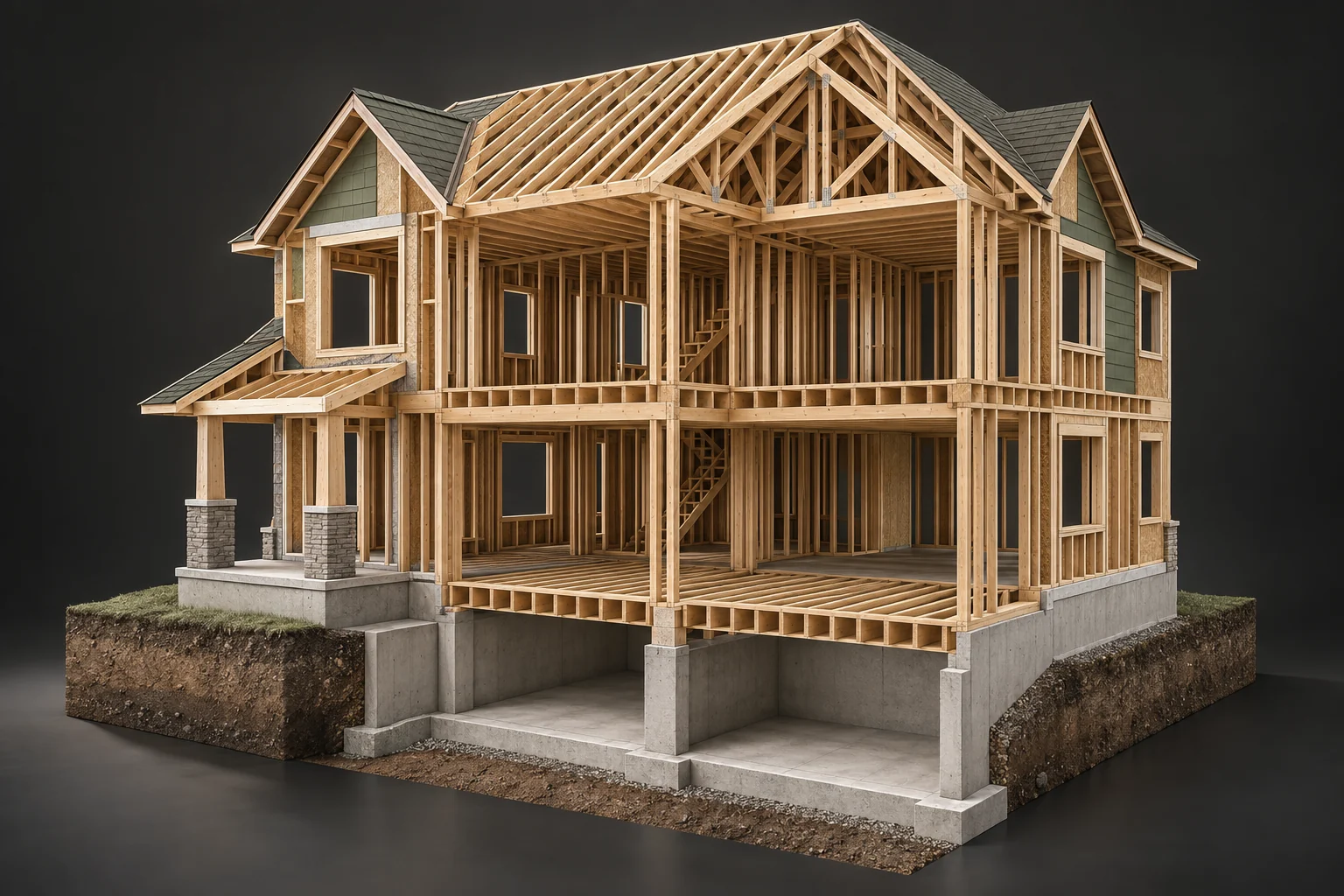
Conceptual architecture. Layout, sizes and routes are illustrative; the picture does not describe your home’s condition.
Explore this in the visual atlas ↗3 picture lessons appear beside the questions in this guide. Use them to understand the explanation, then consider what it means for your home.
Measure exposure, not a moment
Radon is a radioactive gas that can enter buildings from the ground. Levels vary over time with building conditions, weather and occupancy. An individual high reading is different from a representative estimate of long-term exposure. A short low reading cannot establish that a home has a low annual level.
The graph uses illustrative fluctuations to explain this distinction. It is not measured data from a property, a prediction for a neighbourhood, or a substitute for a test. A map or neighbouring home’s result cannot determine your home’s radon level.
Possible entry geometry is not a radon result
The model shows a concrete floor-to-wall junction, a short collared open-ended section at the wall and an exposed soil-and-stone cut face. Timber framing and the front display edge provide specimen context; there is no visible gas or concentration.
Numbers identify the parts explained below.
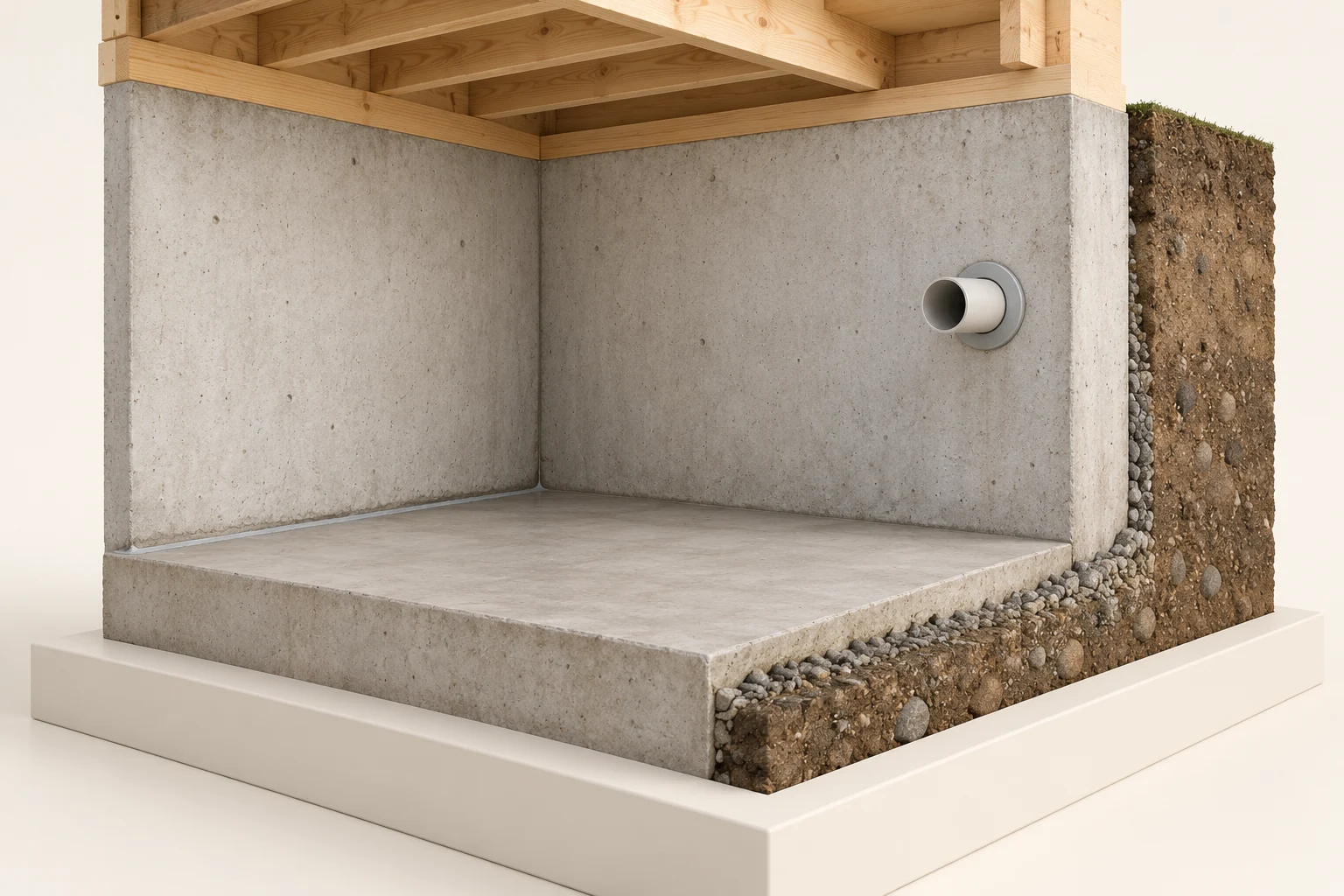
- Floor-to-wall junction
The visible junction is a place to ask about building context and possible entry routes. Its appearance cannot establish leakage, sealing performance or the home’s radon level.
- A short wall section
The collar and open end are visible; the far endpoint and full service route are not. Do not infer an identified radon pipe, a particular concealed connection or an actual entry path from this specimen.
- Ground-contact context
Soil and stones appear in the display cut face. Their appearance does not measure soil gas or predict this home’s occupied-space concentration; a neighbouring result or map does not supply that measurement.
What does this illustration leave out?
The other side and full route of the wall section are unseen. Soil gas, pressure relationships, concealed continuity, actual entry paths and occupied-space radon levels are unknown. The cut face is a model display, not an excavation or an installed wall-layer specification. A visible interface does not prove a leak or defect, and this picture does not identify a representative sampling location. This illustration explains an idea. It is not an installation guide.
What actual measurement record represents the home’s occupied space, and what can the building interfaces add without pretending that radon is visible?
Explore this with HomeAI ↗Opens an editable question. Nothing is sent until you choose to send it.Plan the measurement properly
Health Canada recommends a long-term test of three to twelve months, with at least 91 days of measurements, in a normal occupancy area on the lowest lived-in level. Placement and timing matter. Follow the current instructions for the specific detector or electronic monitor and plan at least 91 days of the test during the heating season. A below-guideline result with fewer than 91 heating-season days may underestimate the annual average; use current result-specific retesting guidance.
Record the test start, location, duration and any unusual ventilation or occupancy changes. Avoid deliberately changing normal living conditions just to lower a result. Use a measurement method and quality-control process appropriate to the purpose, and ask a certified professional when test conditions or interpretation are uncertain.
A device, a room and a record answer different questions
A plain dark rounded case sits on a low interior table. A green chair, closed-looking window and lamp provide room context. Blank lined cards and a closed green folder are illustrative record placeholders; they contain no test dates, concentration or result.
Numbers identify the parts explained below.
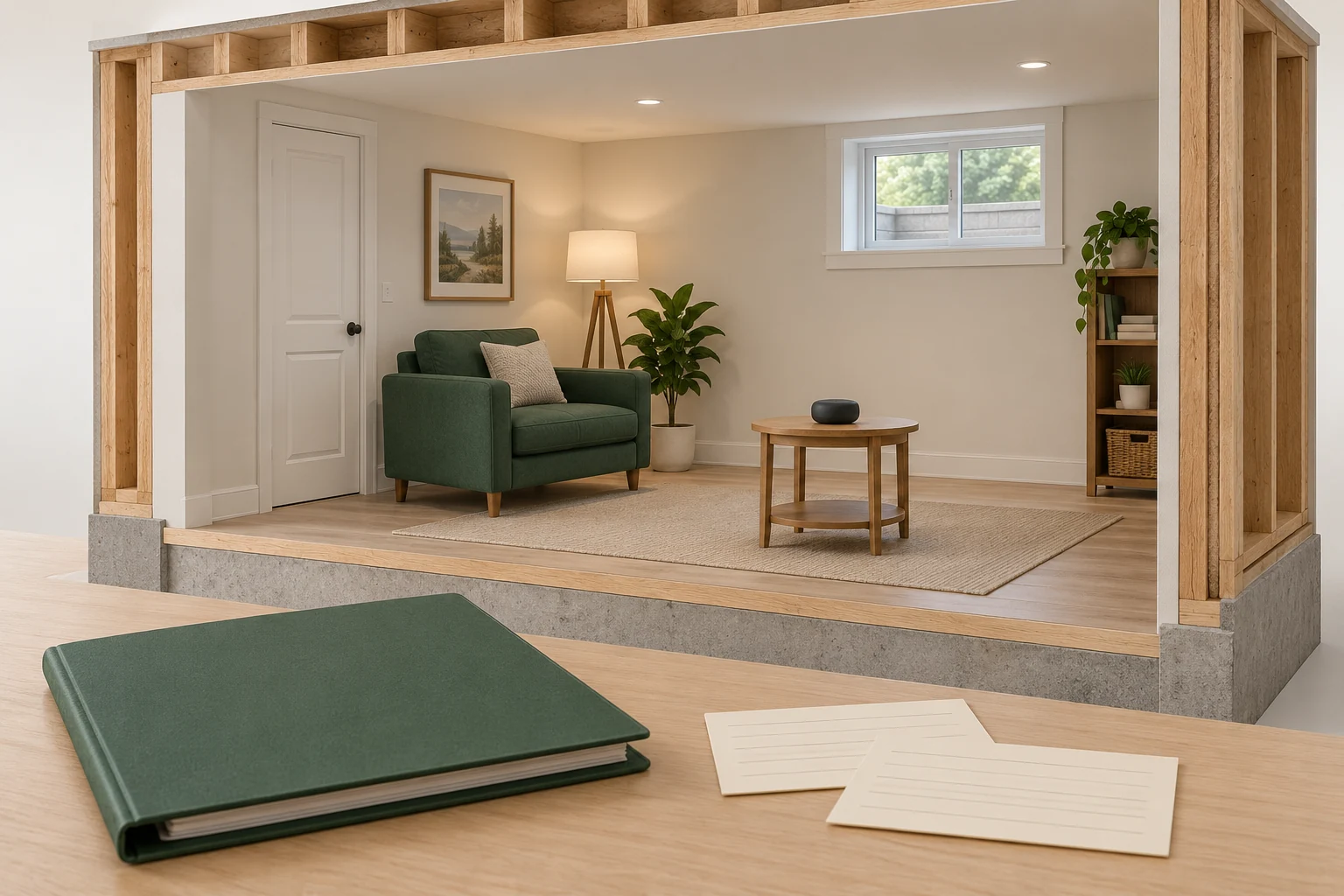
- Identify the actual method
The closed rounded case has no display or label. Match the actual device and method to its instructions and retained measurement history; the model does not identify an approved product or show a reading.
- Keep the measurement context
The lined cards and folder are placeholders. The actual dates, averaging period, device history, room and seasonal/operating context must accompany the real result; no date or finding can be read from this artwork.
- Name the occupied space
The chair illustrates a room-use question. It does not prove how this room is occupied, which level it represents or whether the pictured case meets placement guidance. Intended future room use needs its own clearly described context.
What does this illustration leave out?
The case does not identify a detector type, model, method or calibration. Actual placement distances, regularly occupied level, occupancy, measured interval, averaging period, heating-season coverage, data availability and ordinary operating conditions remain unknown. The depicted table position is not a validated placement. Furniture and a closed-looking window do not establish representative test conditions or safe room use. This illustration explains an idea. It is not an installation guide.
Which actual device, location, dates, averaging period and ordinary-use conditions support the radon result I have, and which fields still need to be recovered?
Explore this with HomeAI ↗Opens an editable question. Nothing is sent until you choose to send it.Interpret the action threshold
The Canadian guideline is 200 Bq/m³. Current Health Canada guidance says that at 200 Bq/m³ or higher, corrective action should be taken within one year. Older documents may contain different timing language; use the current guide linked here. A concentration below the guideline is not a declaration of zero risk.
A certified radon mitigation professional can assess the building and suitable mitigation. Active soil depressurization is a common approach, but the design depends on the house. Do not attempt to design a mitigation system from a diagram or generic chatbot answer.
Read the wording and uncertainty together. Health Canada's current consumer brochure tells readers to act within one year at 200 Bq/m³ or higher; its technical home-measurement guide describes corrective action above 200 Bq/m³, sooner at higher levels. The technical guide also explains that a result near the reference level has measurement uncertainty. These slightly different formulations do not make a displayed value at the boundary risk free, justify delaying professional advice, or turn rounding into a health decision. Keep the full report and ask the measurement professional to explain its uncertainty and recommended action.
Prove what changed
After mitigation, follow current post-installation measurement and maintenance guidance to confirm performance. Installation of a fan or a pipe is different from evidence that occupied-space radon levels have been reduced. Keep records of the original test, mitigation work and follow-up measurements.
Radon planning is separate from a carbon monoxide emergency. A CO alarm requires leaving immediately and contacting emergency services from outside; do not wait for a chat answer or search for the source.
Components and concentration need separate evidence
A vertical pipe and closed fan-like housing sit beside a separate wall-fixed U-shaped tube containing teal liquid. The tube has no scale or visible connection to the pipe. The upper pipe is cropped and its lower collection route is unseen. Blank cards and green folders represent separate records, with no dates or results.
Numbers identify the parts explained below.
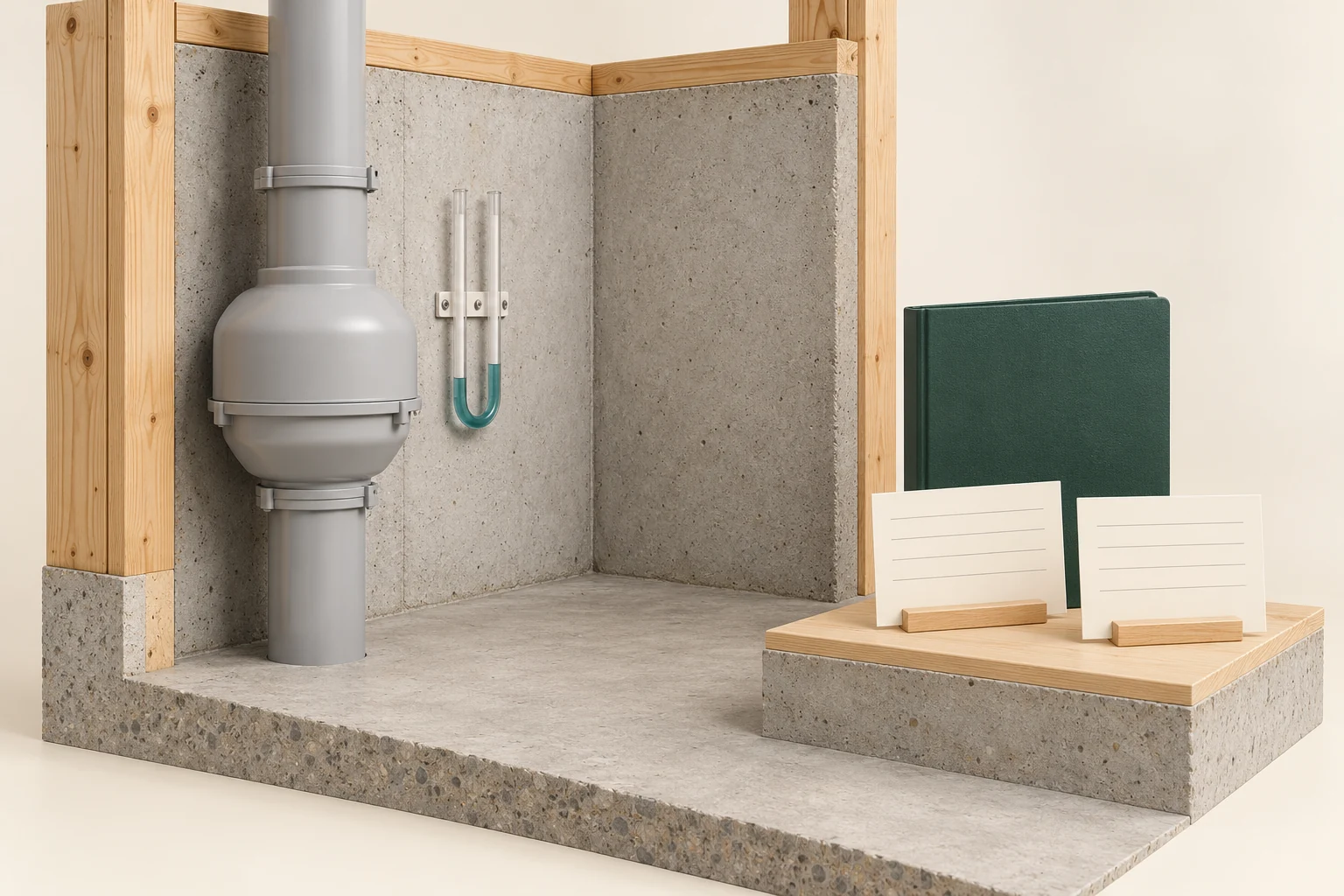
- A component is one fact
A pipe and fan-like housing can prompt an identity and work-scope request. This closed specimen does not prove powered operation, a complete collection/discharge route or a reduced occupied-space radon level.
- Indicator scope remains separate
An identified and appropriately connected U-tube can represent differential pressure; that is not a Bq/m³ measurement or a measured flow rate. This pictured tube has no visible pipe connection, scale or recorded pressure. Treat its liquid as a specimen feature, not a running-system result.
- Verify the outcome
The blank cards stand for distinct original measurement, work scope and follow-up records. Ask what the post-installation verification and representative follow-up actually establish; a pipe, fan, label or invoice does not supply the occupied-space result.
What does this illustration leave out?
Component identity, powered operation, collection arrangement, concealed route, discharge location, installed scope and occupied-space concentration remain unknown. The U-shaped tube is an unconnected specimen shape; its pictured liquid supplies no system pressure, flow or radon value. The geometry is not an approved installation, a required fan location or a do-it-yourself design. Blank work records prove neither completion nor effectiveness. This illustration explains an idea. It is not an installation guide.
Which installed-work records, initial verification and representative follow-up measurements demonstrate the outcome, beyond the visible pipe, fan-like housing or indicator?
Explore this with HomeAI ↗Opens an editable question. Nothing is sent until you choose to send it.Make the result interpretable
A radon result needs its measurement period, device, placement and relevant operating conditions. Comparing two homes without those details can compare methods rather than exposure. A result from a rarely used storage area may not answer the question for the lowest regularly occupied space. Follow current placement guidance and preserve the original report.
A short peak can attract attention without representing a longer average. Conversely, a low momentary value can coexist with a higher longer-term result. The conceptual variation graph illustrates that distinction; it is not a predicted trace for your address. A neighbourhood result is context for deciding to measure, not a substitute for a home measurement.
A mitigation report should describe the work and how effectiveness was checked. A rough-in, fan or labelled pipe is not itself a verified post-mitigation result. Ask for the measurement dates and follow-up method. If a buying timeline is shorter than the representative test period, acknowledge that limitation rather than presenting an abbreviated reading as equivalent evidence.
Connect the finding to the right professional
A qualified radon professional can help with placement, interpretation and mitigation planning. A realtor can coordinate evidence and explain the transaction questions with the relevant advisors. HomeAI can explain the measurement framework; it cannot promise a safe concentration, diagnose health conditions or determine contractual obligations.
A seller’s evidence pack should preserve pre-work and post-work records without compressing them into “radon solved.” A buyer should check whether the report applies to the current configuration and occupied levels. Renovations and operating changes can affect the home as a system, so ask the measurement professional whether further testing is appropriate.
Keep the averaging period beside the result
Radon varies over time, and an hourly value and a representative long-term average answer different questions. Health Canada's home-measurement guidance calls for at least 91 days of testing during the heating season for the intended representative estimate. Record the start and end dates, heating-season coverage, device, placement and normal occupancy context alongside the result.
A report labelled long term is easier to use when those details are available. If the dates or location are missing, ask for the original record rather than treating the label as enough. A brief high reading does not by itself describe the average annual concentration, and a brief low reading does not clear the home. Use current guidance to interpret the longest representative evidence available.
Placement also affects which occupied space the test represents. Preserve the actual room, level and operating context without inventing that a device was in the correct location. Home renovations or changed use can raise a new applicability question. Ask the measurement professional whether the existing record answers that question; do not automatically require a new test for every missing document.
Keep the measurement and its context together.
This reading worksheet names what to retain. It collects nothing and supplies no concentration, completed test, diagnosis or health clearance.
- Question and occupied space
- What is being assessed, for which ordinary occupied room or intended use?
- Address, room and floor
- Preserve the report’s property and placement context, including relevant device moves.
- Device and provider
- Retain the actual method, model or identifier, provider and applicable instructions.
- Measured interval and coverage
- Keep start and end dates, the reported average and available data coverage. A screenshot or invoice date does not establish the interval.
- Season and ordinary conditions
- Keep heating-season coverage, occupancy and relevant ventilation or operating changes. Heating use and region matter.
- Result and qualifications
- Retain the full result, averaging period, uncertainty or applicable qualifications and professional interpretation.
- Construction or mitigation scope
- Keep what was delivered or changed, owner instructions and accessible component records separate from concentration results.
- Verification and follow-up
- Distinguish the initial short verification from the later representative long-term test; keep relevant home or use changes and the next responsible person.
After work, keep the stages distinct.
- Original measurementThe report and occupied-space location establish what was measured before the work.
- Installed-work recordThe system description and instructions explain the actual work. A fan or pressure indicator is not a room-concentration report.
- Initial verificationHealth Canada’s September 2026 factsheet describes a certified professional’s short-term check after the system is turned on.
- Representative follow-upThe factsheet then describes a long-term test in the first heating season, in the same location as the original test.
Calendar duration, available measurement data and representativeness remain separate questions. The worksheet does not certify a test or replace current result-specific interpretation. Retain source wording and uncertainty beside the result, and ask a certified radon professional when the conditions or next step are uncertain.
Source scope: Health Canada, Guide for radon measurements in homes, page details May 22, 2026; device, room, timing and report context. Reduce radon in your home, September 2026 factsheet, page details September 22, 2026; distinct verification stages. Reviewed October 3, 2026. National education and recommendations do not establish local code or warranty obligations.
Work through a fictional monitor screenshot
A fictional owner has a screenshot of a monitor's seven-day average and a note saying the basement may become a bedroom. No start date, placement record or representative long-term result is available. The screenshot is genuine evidence of a displayed value at that time, but cannot be promoted into the representative test context needed for the intended decision.
The owner asks for the device and measurement history, identifies the intended regularly occupied level, and plans testing under current Health Canada guidance. A qualified radon professional can help when placement, interpretation or mitigation is uncertain. The household does not use an open window or an ordinary ventilation change as proof that radon has been resolved.
If mitigation is later performed, retain the original assessment, work scope and effectiveness verification as separate records. A fan, pipe or rough-in is evidence of a component rather than a measured outcome. The worked example does not determine health effects, contractual obligations or a safe short-term threshold; it makes the missing measurement context visible and defines the next question.
Choose a device that can retain the intended test
A passive detector and an electronic radon monitor can both support a long-term measurement, but they preserve the evidence differently. A passive detector accumulates a signal while it is exposed; a laboratory reads that signal after the test. Its start and end dates must therefore be recorded by the person deploying it. An electronic monitor measures repeatedly and may display several averaging periods. Its newest hourly figure, seven-day figure and complete-test average are different outputs. Before choosing a device, ask which output will answer the planned measurement question and how it will be retained.
Health Canada recommends long-term devices that have passed Canadian National Radon Proficiency Program performance testing. Check the actual model against the applicable list rather than relying on a generic air-quality badge or a retailer's use of the word approved. The technical guide does not rank one listed device above another. For a passive kit, retain the identifier, expiry information, provider instructions and laboratory return requirements. For an electronic monitor, check its manual for data storage, power-loss behaviour and access to the long-term average. Some monitors cannot retain a complete long test without periodic downloads; a bright screen alone does not establish complete coverage.
A measurement service can add useful quality assurance and interpretation. Ask who carries out the measurement, who analyzes any detector, and what report will be delivered. Health Canada's technical guide directs professionals and laboratories to C-NRPP quality-control and quality-assurance practices. Certification of the provider and suitability of the particular device answer different questions, so retain both. If a device was moved, damaged or lost data, preserve that event and ask the provider how it affects the evidence. Do not silently join periods from different rooms or erase an inconvenient interruption. A useful record makes the measurement's history recoverable.
Read the complete report before comparing homes
A report is easier to assess when its address, test dates, room, floor, device identity and averaging period travel with the result. Health Canada's report guidance for measurement professionals and laboratories calls for the result in Bq/m³ with its measurement uncertainty, or an appropriate statement about a result below the detection or quantification limit. It also asks for comparison with the guideline and relevant qualifications about the testing conditions. Supplementary information can include the device's model and validity information, provider details and placement photographs. A homeowner using an electronic monitor may not have an equivalent formal report, but can still retain the actual history and clearly identify what is missing.
Read a qualification for what it changes. A test outside the preferred seasonal coverage is evidence of the concentration during that period, although it may underestimate the annual average. A device in a nonstandard position may describe that position without representing the intended occupied area. Those records do not become meaningless, but their claims need to remain limited. A measurement professional can explain whether the next step is recovering context, repeating a representative measurement or taking corrective action. Avoid reducing a detailed report to a coloured pass symbol that hides its conditions.
The seasonal decision is also result specific. The current technical guide recommends retesting in the next heating season when a test has fewer than 91 heating-season days and its result is below 200 Bq/m³. A test lasting at least 91 days that is above the guideline calls for action even if it was conducted outside the heating season; winter testing is not a reason to postpone that response. Heating season refers to the period when heating is actually used and varies with climate and region. Preserve the test's dates and operating context rather than assuming a single calendar window applies across Canada.
Identify the new-build system that was actually delivered
New construction offers an opportunity to provide soil-gas control before the building is closed in. It does not reveal the home's eventual occupied-space concentration. A rough-in, a complete passive stack and an active system are different arrangements. A capped rough-in provides a future connection, together with other specified construction provisions; it is not a complete operating radon-control system. A passive stack continues the path to an outdoor discharge and relies on natural pressure differences. An active soil depressurization system uses a fan to establish the intended pressure relationship and move soil gas outdoors. These descriptions explain the mechanism, not a recipe for converting a pipe.
Health Canada's September 2026 factsheet recommends a passive soil depressurization system in all new homes. Treat that as a national public-health recommendation, not proof that every province, municipality or particular construction date requires the same system. Ask the builder what was actually included, where the accessible labelled components are, and which drawings, installation records and owner instructions describe the concealed work. A photograph of one pipe end cannot establish the complete below-floor collection path, barrier continuity or final discharge arrangement. Local requirements and any warranty question need their own applicable records and advisors.
Keep construction evidence and measurement evidence in separate parts of the handover pack. The first records what was built; the second records what a suitable test measured. The current measurement guide recommends testing in the first heating season after occupancy and retesting a newly built home two years after its year of construction. The factsheet still calls for a long-term heating-season test where a new home has a passive stack, an active system or an HRV/ERV. Neither a new-home label nor installed ventilation supplies the missing concentration result. Retain the plan with the responsible person and expected reporting point.
Separate component checks from measured effectiveness
Active soil depressurization aims to intercept soil gas beneath the building and discharge it outdoors. Its fan and piping belong to that control path. The room measurement asks what concentration remains where people spend time. A labelled fan, an audible motor or an installation invoice may support the equipment record, but none reports the occupied-space concentration. Where a system has a U-tube manometer, its liquid-column difference indicates differential pressure. It is not a radon detector and its scale is not Bq/m³. Ask the installer to explain the particular indicator and the supplied operating instructions; do not invent a universal normal mark.
Health Canada's current reduction factsheet describes two verification stages. After the system is turned on, a certified professional performs a short-term test to check the reduction. A long-term test follows in the first heating season, in the same location as the original test, to give more representative evidence of the reduced annual average. Preserve which stage each report belongs to. A short commissioning check has a useful purpose, but presenting it as the completed long-term exposure assessment would overstate its reach. Ask the professional to specify the follow-up plan and explain any remaining performance question.
Keep the original result, installed scope, initial verification, later long-term result and maintenance instructions together. Record an observed change in the accessible equipment or an indicator and refer it to the service professional without disconnecting the fan, opening the pipe or changing controls to run an experiment. Health Canada's measurement guide recommends five-year retesting for homes with active mitigation systems, alongside event-related follow-up. A maintenance invoice and a concentration report can both be useful; one should not erase the need for the other. The intended outcome is an understandable evidence chain, not a permanent radon-solved label.
Carry the evidence through a move or a home change
A home's measurement history should travel with the home and remain understandable to the next household. A buyer can request the full existing reports, occupied-space locations, system description and follow-up records early. A seller can supply those records without translating a limited result into a guarantee for future occupants. If the transfer timetable is shorter than a representative measurement, identify what can be learned from existing evidence and what remains a post-possession testing task. A realtor can coordinate the records and relevant specialists; contractual terms, disclosure obligations and responsibility for costs require the appropriate advisors rather than a generic radon clause.
An older report can still be informative, while later changes create a new question about applicability. Health Canada's current guide recommends retesting in the next heating season after renovations affecting structure or ventilation, energy retrofits, significant earthwork beside the home, or new noticeable damage to ground-contact construction. It also identifies a basement or main floor that becomes the lowest lived-in level without having been tested. Record the actual event and intended use rather than demanding a new measurement after every cosmetic change. The next decision should match what changed and the evidence already available.
Consider an explicitly fictional purchase file: a builder's sheet identifies a capped rough-in; the seller provides an older report from a main-floor living room; the buyer plans a basement office. No concentration values or dates are supplied in this example. The rough-in sheet answers a construction question. The room report answers a measurement question for its recorded period and location. The planned office raises the occupied-level question. The buyer requests the complete report and construction instructions, records the intended use, and asks a certified measurement professional about the appropriate long-term plan. That organised handoff is more useful than calling the house clear or rejecting it from a component photograph.
Keep learning about the connected parts
Practice the distinction.
Seven days on a screenshot
Fictional learning scenario: a brief monitor display is available while future room use is changing.
Reported observations
- The displayed averaging period is short.
- Placement and longer history are unavailable.
Compare the explanations
Expand each possibility to see the evidence needed to distinguish it. Similar symptoms can have different mechanisms.
Useful limited observation
The screenshot may document that moment without establishing a representative result.
The original device history and measurement context.
Additional representative evidence needed
The intended decision may require a suitably planned long-term test.
Current guidance and qualified interpretation where needed.
A useful next question
Recover the context and plan representative testing for the intended occupied space.
No short-term reading is treated as home clearance.
Know what the words mean.
- Representative average
- A result supported by a measurement period and placement suited to the intended exposure decision.
- Heating-season coverage
- The portion of the recorded test period occurring during the heating season.
- Differential pressure
- The pressure difference between two points; an appropriately connected pressure indicator does not measure occupied-space radon concentration.
- Radon rough-in
- A construction provision for later radon-system work, whose actual completed scope must be identified; its presence alone is not a measured reduction in occupied-space radon.
- Post-mitigation verification
- Measurement after installed work to assess its effect, with method, dates, location and purpose retained; initial verification and representative follow-up are separate evidence.
Questions to bring
to the conversation.
- What was actually observed?
- Which part was assessed, and what was inaccessible?
- What record supports the conclusion?
- Who can resolve the remaining technical question?
Separate a showing observation, an existing record and a new professional assessment. Unknown means a question remains; it does not automatically mean a defect.
Use the evidence planner ↗Go to the source.
Original HomeAI explanation informed by these public references. Sources support the underlying guidance; they have not reviewed or endorsed HomeAI. Diagrams are conceptual, and calculator outputs depend on your inputs.
Publication & source review
First published .
Sources reviewed .
- Health Canada · Radon measurement guide
- Health Canada · Using a radon monitor or detector
- Health Canada · Reducing radon levels at home
- Health Canada · Preventing carbon monoxide exposure
- Health Canada · Radon measurement guide for homes
- Health Canada · Using a radon monitor or long-term detector
- Health Canada · Reduce radon in your home (2026 factsheet)
Where this reference applies
Jurisdiction: Canada; federal public-health education and recommendations
Publisher publication date: 2026-09
Publisher modification date: 2026-09-22
Source reviewed: 2026-10-03 · UTC
Freshly read substantive rendered HTML: mitigation mechanisms, certified short-term verification followed by a same-location first-heating-season long-term test, regular retesting, and passive soil-depressurization recommendation for new homes. Original HTML retrieval timed out; no original download or linked PDF read is claimed. Generic percentage reductions, installation-time/cost statements and safe-home language are not property-specific promises. This is not proof of local code, warranty coverage or an installed system's measured performance.
- Canadian General Standards Board · Radon control options for new buildings (2024)
Where this reference applies
Jurisdiction: Canada; CAN/CGSB-149.11-2024 technical standard, with application depending on the actual project and jurisdiction
Edition: CAN/CGSB-149.11-2024
Source reviewed: 2026-10-03 · UTC
Fresh official PDF text read at the cover, physical PDF pages16–20 (printed7–11) for rough-in/passive/active and differential-pressure concepts, and pages60–61 (printed51–52) for owner-information/component monitoring. Seventy-page original PDF was not downloaded or read in full. No numeric sizing, pressure target, discharge clearance, installation recipe, code adoption, universal construction duty or performance guarantee is drawn from it.
Have a question about your home?
Start with the symptom, timing and what you have observed.
Ask HomeAI