- Describe the exact component, work and location. A repair invoice is useful history within its stated scope.
- Keep the concern, assessment, work and follow-up in order. Painting and a current photograph do not replace a repair investigation.
- Ask qualified local professionals about unresolved building questions, disclosure and the actual sale agreement.
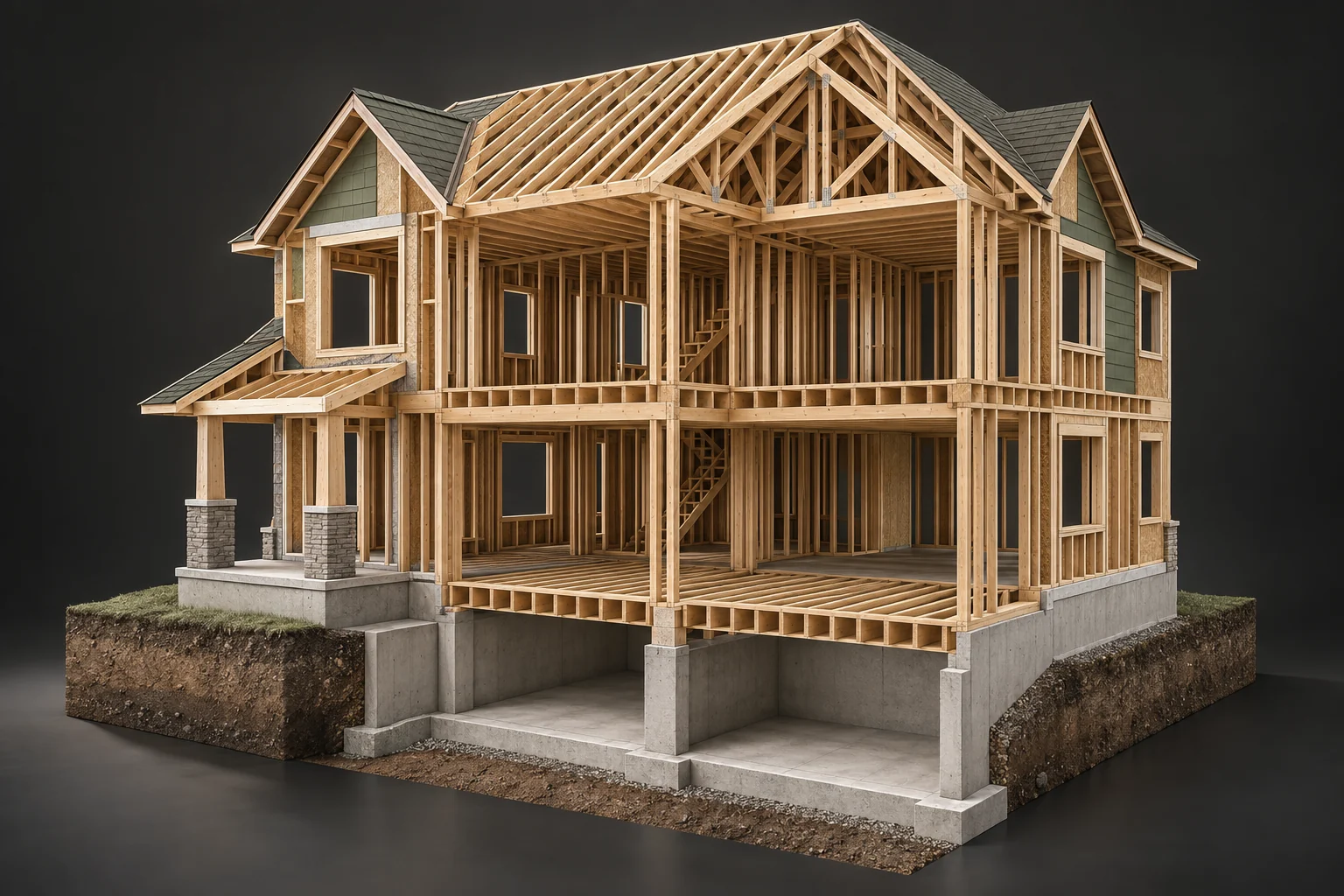
Conceptual architecture. Layout, sizes and routes are illustrative; the picture does not describe your home’s condition.
Explore this in the visual atlas ↗2 picture lessons appear beside the questions in this guide. Use them to understand the explanation, then consider what it means for your home.
What do you actually know about your home?
Start with the questions a buyer will have: what changed, why was work needed, who did it and what remains unresolved? A useful seller file answers those questions with a short history and the original documents. You do not need to turn every receipt into a technical report. You do need to say clearly what each record describes.
Separate things you saw from things someone told you. “I saw water below the dining-room window during rain” is your observation. “The contractor said the joint needed sealing” is an attributed account: a statement linked to the person who supplied it. A written assessment may contain a finding. Keep these descriptions attached to their sources rather than merging them into one stronger claim.
Give each event a location and date, using “approximately” when your memory is uncertain. The day a problem occurred, the day a provider visited and the day an invoice was issued can differ. An evidence index is simply a list that helps readers find those original records. It should make your history easier to follow without filling gaps from memory.
Which problems need attention before cosmetic work?
Paint, flooring and staging change how a room looks. They do not investigate why a stain, repeated leak or electrical concern appeared. Bring an active problem to the appropriate professional before deciding on finish work. Ask them to explain the cause they assessed, the proposed repair and any follow-up. If the cause is still uncertain, keep that uncertainty in the work plan.
For a window-area stain, rain entry and a nearby plumbing issue are different possible explanations. Record when you noticed it and provide the existing repair history; do not decide the cause from the stain’s shape. A provider needs to assess the actual location and conditions. Ask how the recommended work addresses their finding and what would indicate that further investigation is needed.
Older finishes can add another planning question. Health Canada warns that disturbing some asbestos-containing materials or lead-containing paint can release hazardous fibres or dust. Describe the proposed work before anyone cuts, sands or removes unfamiliar material. Arrange qualified assessment when relevant; do not collect samples or open concealed layers yourself to prepare a listing.
What should each repair record explain?
Keep four parts of the story together: the original concern, any assessment, the work described and any later check. The concern tells a reader why someone was called. The assessment explains what the provider investigated or found. The work record identifies the tasks. A follow-up record describes any later observation or verification. A file may contain only some of these parts; show which are missing.
For each document, record the address, room or component, provider, relevant dates and stated scope. Scope means the boundaries of the job: sealing a named joint is narrower than replacing a window, and replacing a window is narrower than assessing every exterior wall. Keep exclusions and qualifications with the original record. An invoice can accurately describe billed work while leaving the cause or result unanswered.
Do not rewrite a sequence to make it look complete. If the invoice date is later than the reported work date, record both. If painting followed a repair, preserve its separate receipt and task description. Ask the provider about a significant gap rather than supplying a diagnosis yourself. The picture below follows document roles; it does not show a successful repair.
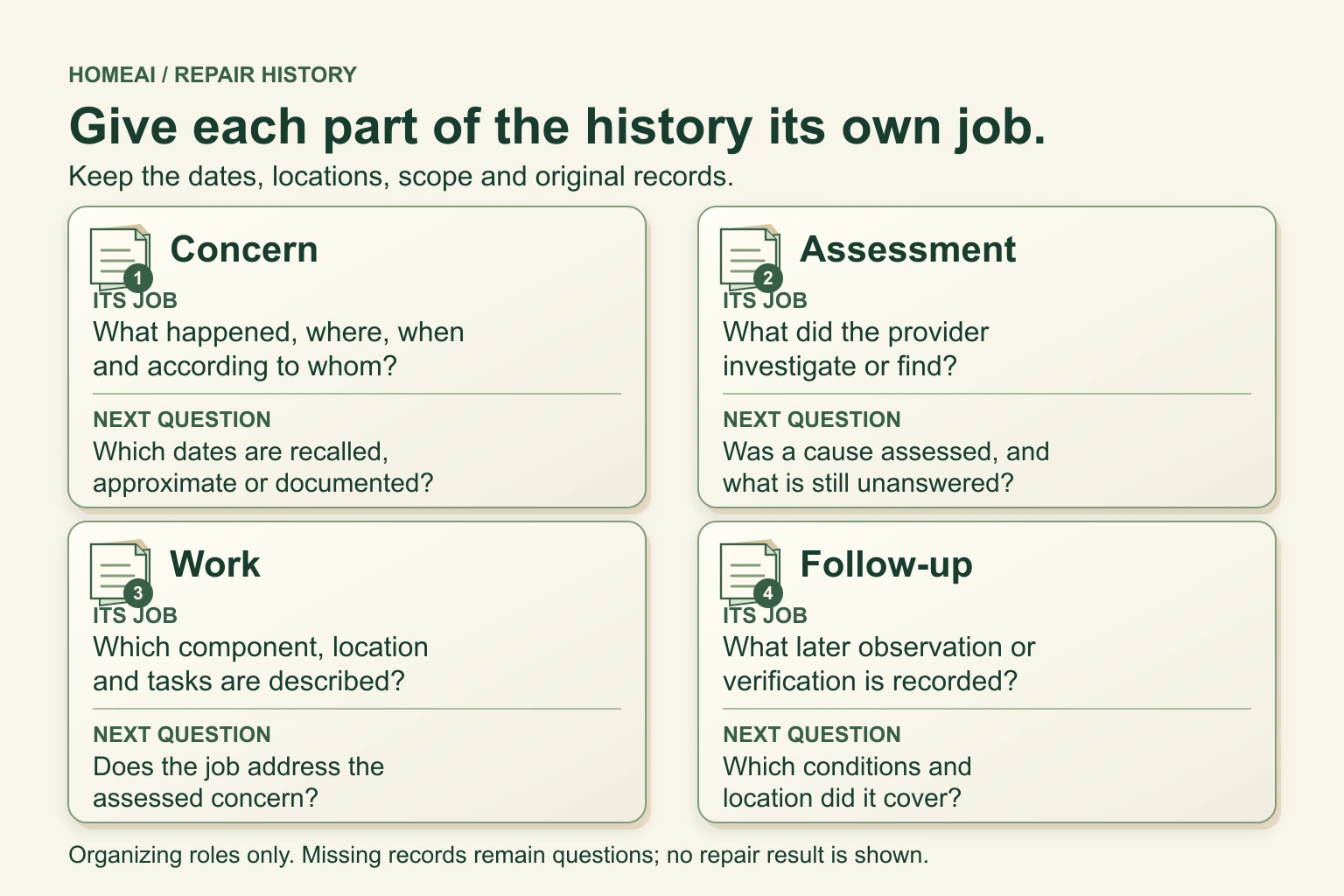
Give each part of the repair history its own job
Four equally sized cards organize a repair history into the concern, assessment, work and follow-up. Each includes the information to keep and a question to ask.
Numbers identify the parts explained below.
- Concern
Record what was observed or reported, where, when and by whom. Next question: Which dates are recalled or approximate, and which are documented?
- Assessment
Keep the provider’s investigated question, findings, methods and access limits. Next question: Was the cause actually assessed, and what remains unanswered?
- Work
Keep the named component, location and tasks described in the contract or invoice. Next question: Does the described job address the assessed concern, and what was excluded?
- Follow-up
Record any later observation or verification with its date, location and conditions. Next question: What does the later check actually cover, and which performance question remains open?
What does this illustration leave out?
This is an organizing example, not a completed property file. Some records may be missing and dates may differ. Ask the actual provider what was assessed, what work was done and what later check exists. Keep the original documents and their dates, locations, scope and qualifications. A missing record remains an open question.
Which concern, assessment, work and follow-up records exist, and what does each one actually explain?
Explore this with HomeAI ↗Opens an editable question. Nothing is sent until you choose to send it.Keep the concern, assessment, work and follow-up together.
These four parts help organize a history. A particular file may have missing parts or different event and document dates; the arrangement does not establish a successful repair.
- Concern
- Its job: Record what was observed or reported, where, when and by whom.
- Next question: Which dates are recalled or approximate, and which are documented?
- Assessment
- Its job: Keep the provider’s investigated question, findings, methods and access limits.
- Next question: Was the cause actually assessed, and what remains unanswered?
- Work
- Its job: Keep the named component, location and tasks described in the contract or invoice.
- Next question: Does the described job address the assessed concern, and what was excluded?
- Follow-up
- Its job: Record any later observation or verification with its date, location and conditions.
- Next question: What does the later check actually cover, and which performance question remains open?
Four parts of a useful repair history
- ConcernWhat was observed or reported, where, when and by whom? Keep memory and approximate dates identified.
- AssessmentWhat did the provider investigate or find, using which methods and access? Keep the original scope and limits.
- WorkWhich location, component and tasks were described in the contract or invoice? Do not broaden one task to the whole system.
- Follow-upWhat later observation or verification exists, for which conditions and location? State the missing answer if no relevant record is supplied.
Do the plans and permit records match the home?
Compare supplied records with the work you know about: a basement alteration, added deck, replaced equipment or changed room layout. Begin with the address, described work and record status. If a document appears to concern a different location or task, ask the municipality or responsible provider to explain the mismatch. A missing entry is a question to investigate, not an automatic finding that work was unlawful.
Calgary provides online permit information and a property-research service for further records. Its current research page warns of delays and says file contents cannot be guaranteed. Start important requests early and confirm the current access process. This is a Calgary example; other municipalities keep and release records differently. Obtaining a file does not replace an assessment of present condition.
A Calgary Certificate of Compliance serves a specific purpose: it addresses structure locations under the Land Use Bylaw on a Real Property Report. The City says it does not confirm building-code requirements or permit history. Ask your transaction advisor what documents your actual sale needs. The linked NRC codes FAQ is archived and offers historical context only; it does not establish today’s requirements for this address.
What should you ask about disclosure?
Give your licensed real-estate professional and legal advisor the known concerns, original records and unresolved questions before they prepare or review sale documents. Ask what your province’s process and actual agreement require. Accurate history is useful to that discussion, but a HomeAI checklist cannot classify a defect or decide your legal obligations.
British Columbia’s regulator distinguishes sellers’ disclosure duties from the broader professional duties of licensees. BCFSA also describes the property disclosure statement as voluntary in BC; choosing a form does not settle a known-defect question. Its guidance directs uncertain questions to the licensee or independent legal advice. This example is specific to British Columbia, rather than a form rule for Canada.
Alberta’s RECA Rules address licensees and representation relationships; Rule 57 includes disclosure of material latent defects known to a licensee acting as a seller’s sole agent. The linked text displays a July 17, 2023 revision date. Ask your advisor to confirm the rules and duties relevant to your transaction. Québec has its own brokerage forms and guidance; confirm current requirements with the appropriate local professional instead of transferring an Alberta or BC example.
How do you describe an upgrade accurately?
Name the actual component and job. “Kitchen tap replaced” tells a reader more than “new plumbing.” “Insulation added in the accessible attic area described in the invoice” is more useful than “fully insulated.” Use the provider’s documented location and scope. Keep the broader parts of the system outside that description unless a relevant record actually addresses them.
An energy evaluation has another job. NRCan’s EnerGuide rating estimates a home’s energy performance using standard operating conditions. Its homeowner information sheet and renovation upgrade report provide context for the rating and proposed improvements. Read those documents with their dates and assumptions; do not turn an upgrade recommendation into a statement that work was completed.
Actual energy use also depends on the household and weather. NRCan cautions that bills should not be expected to match the EnerGuide estimate. Provide actual upgrade records and the complete evaluation separately. A new component, a modelled energy result and a future buyer’s costs answer different questions. The scope diagram helps you keep a precise upgrade description attached to the work.
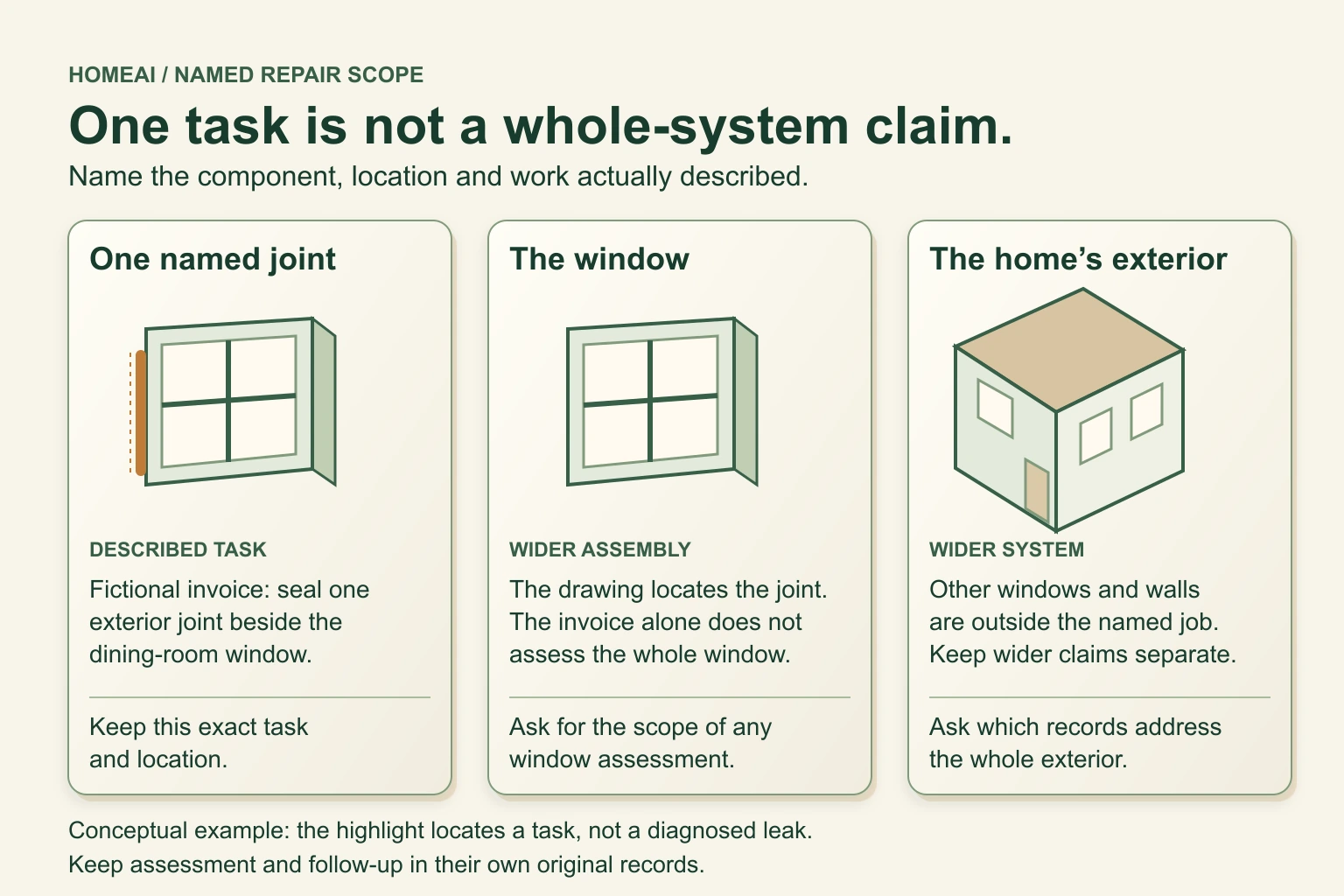
Describe one joint repair as one joint repair
A small highlighted joint sits beside a conceptual window. Separate panels name the billed task, the wider window assembly and the home exterior.
Numbers identify the parts explained below.
- One named joint
A fictional invoice describes sealing one exterior joint beside a dining-room window. Quote that task and location accurately.
- The window assembly
The window is shown to locate the joint. The invoice alone does not describe replacement or assessment of the complete window.
- The home’s exterior
Other windows and walls are outside the named job. A claim about the whole exterior needs records and assessment with that wider scope.
What does this illustration leave out?
The highlighted joint only locates a fictional task. It does not identify a leak source, specify a sealing method or prove a repair result. Ask what the actual invoice and any assessment cover before making a wider claim. Describe the actual component, location and task. Keep diagnosis and follow-up in their own original records.
Does the upgrade description name the documented job, or does it claim work on a wider window or exterior system?
Explore this with HomeAI ↗Opens an editable question. Nothing is sent until you choose to send it.One task is not a whole-system claim.
The fictional invoice names one exterior joint. The window and home drawings show wider areas that the same task description does not assess.
- One named joint
- A fictional invoice describes sealing one exterior joint beside a dining-room window. Quote that task and location accurately.
- The window assembly
- The window is shown to locate the joint. The invoice alone does not describe replacement or assessment of the complete window.
- The home’s exterior
- Other windows and walls are outside the named job. A claim about the whole exterior needs records and assessment with that wider scope.
This conceptual picture identifies no leak cause or completed repair. Quote the actual task and location, retain the full original record, and ask the responsible provider about any diagnosis or follow-up.
Keep the description matched to the actual record
- Component replacementName the component and location described. A kitchen-tap invoice does not establish replacement of all plumbing.
- Repair taskName the joint, surface or work area covered. Keep any diagnosis and follow-up in their own original reports.
- Energy evaluationKeep the rating, assumptions and dated reports. Recommended work is not completed work, and modelled energy is not a promise about bills.
- Current observationDescribe what was visible, by whom and when. A photograph of a tidy finish does not assess concealed conditions.
What is included in the contract, estimate and warranty?
Before commissioning pre-listing work, ask for a written scope with location, tasks, materials, access, exclusions and restoration. Who moves furniture, repairs opened finishes or disposes of debris? Which approvals or inspections apply? These details help you understand the proposed job and later explain what was actually done. Confirm provider qualifications for the specific work.
Alberta’s contractor guidance recommends written estimates and contracts covering work, materials, price, timing and guarantees, with changes documented in writing. It also tells homeowners to check permit and inspection requirements with local government. Use it as an Alberta example, and obtain current local advice for your project. This guide does not supply a universal contract, payment rule or cancellation right.
Read a warranty as its own document. Ask the issuer about coverage, exclusions, term, required maintenance and whether a future owner can use it. Record the answer rather than assuming the warranty follows the home. If the proposed sale promises particular work or records, have your legal and transaction advisors address those promises in the actual agreement.
What should the next owner receive?
Prepare a practical handoff: equipment models and manuals, available inspection and permit records, relevant repair documents, maintenance information and unresolved items. Keep the full reports with their limitations. Organize documents by system and location so a new owner can find the furnace manual or the window repair history when they need it.
A short index can state the document name, provider, date, room or component and where the original can be found. Distinguish the date of work from the document date. Mark an unanswered question plainly, such as “follow-up report not supplied.” Do not replace that gap with a statement that the repair passed, was inspected or will never recur.
Share the file through the process agreed with your transaction professionals. Keep unrelated banking details, identity documents and private access information out of a public listing package. Ask what should be transferred, by whom and when. If an important condition changes while the sale is underway, bring the change to your advisors so the relevant history can be updated appropriately.
How do you write a summary without broadening the report?
Use one sentence for the concern and another for the documented work. For example: “The seller reports water below the dining-room window in autumn 2021. The 2022 invoice describes sealing one named exterior joint.” Those sentences identify two sources and two facts. They do not quietly turn the invoice into an investigation of all possible water-entry routes.
Add a separate line for the current observation: who looked, when, from where and what was visible. “No stain visible in this dated room photograph” has a useful, narrow meaning. It does not assess concealed materials or performance in every storm. If a professional completed a relevant follow-up, describe its actual scope and attach the full record.
Give the original document enough room to speak. Keep its qualification, tested location or inaccessible area beside the finding it limits. When two records disagree, name the difference and ask the provider to clarify it. A readable summary helps the buyer reach the original material; it should not improve the original conclusion.
What is a pre-listing inspection for?
A pre-listing inspection can help you understand condition questions before preparing the sale. Decide what you need from it: a general overview, clarification of a particular concern or advice about further specialist assessment. Discuss those goals with the inspector and read the agreement before booking. The agreed scope matters more than the service name.
Alberta’s current guidance requires checking the inspector and inspection business licences, a written contract before inspection and a written report afterward. It tells clients to list the items they want inspected in the contract. This licensing and contract example applies to Alberta. Check the relevant authority and provider qualifications wherever the home is located.
Read access limits and follow-up recommendations carefully. A general non-invasive visit may leave concealed work, unavailable areas or a specialist question unassessed. Ask what additional work would answer the important gap, with appropriate permission. A seller’s report remains useful within its scope; the buyer and their advisors decide what further investigation their purchase needs.
Follow a fictional seller's repair timeline
Fictional example: Amira remembers seeing water below a dining-room window during autumn rain in 2021. Her 2022 service invoice describes sealing one exterior joint. A 2023 receipt describes interior painting, and a safely taken room photograph from 2026 shows no visible stain. Each item gives her a different part of the history.
Amira puts the four items in chronological order, keeping her recalled event date separate from the invoice date. She finds no supplied assessment explaining the original cause, and no professional follow-up linking the sealing work to later rain performance. The missing records do not prove the work failed. They leave a question that the invoice and photograph cannot answer.
She describes the billed joint work and later painting separately, asks the provider what supporting records exist, and takes the known history and remaining questions to her transaction advisors. If a current technical assessment is needed, she arranges it with suitable scope and authorized access. This invented timeline establishes no actual leak diagnosis, concealment, successful repair or legal duty.
Read Amira’s four items in order.
The dates below are invented parts of the worked example, not source statistics or an actual home’s repair history. They show how an event, invoice, finish receipt and later photograph answer different questions.
- Autumn 2021 — Amira’s recalled water eventReported water below the dining-room window during rain. The event date is approximate and the cause is not established.
- 2022 — Service invoiceDescribes sealing one exterior joint. No causal assessment or relevant professional follow-up is supplied in this fictional file.
- 2023 — Painting receiptDescribes interior finish work. It does not establish a water-entry investigation or successful repair.
- 2026 — Safely taken room photographShows no visible stain at that photographed visit. It does not assess concealed layers or performance during other storms.
The fictional file has no supplied cause assessment or relevant professional follow-up. This gap does not establish failed work, concealment or a legal duty. Ask the provider and appropriate local transaction advisors about the remaining question.
Who can answer the remaining questions?
Match the question to the person. Ask the repair provider what their work covered and what verification exists. Ask a qualified building specialist about an unresolved physical concern. Ask the municipality about its permit or completion records. Ask your licensed real-estate and legal professionals about the transaction and disclosure process. One person’s answer should stay within their actual role.
If a professional is described as HAUSE-trained, ask what training they actually completed, what it covered and how it relates to this task. Confirm licensing where required, relevant experience, service scope and current availability. Training does not replace the specialist who needs to assess a building system, and this guide does not establish that a particular realtor or service is available.
Finish with a short list of open questions, responsible people and next actions. Keep the original records as answers arrive. HomeAI can help you understand the terminology and prepare those questions; the final property findings and transaction advice come from the appropriately qualified professionals working on your actual home and sale.
Keep learning about the connected parts
Keep learning about the connected parts
Practice the distinction.
One window-joint invoice and a separate painting receipt
Fictional example: Amira prepares to sell a home with a remembered window-area water event, a service invoice, later painting and a current room photograph.
Reported observations
- Amira recalls water below the dining-room window during autumn rain in 2021.
- A 2022 invoice describes sealing one named exterior joint; no causal assessment is supplied.
- A 2023 receipt describes painting, and a safely taken 2026 photograph shows no visible stain.
Compare the explanations
Expand each possibility to see the evidence needed to distinguish it. Similar symptoms can have different mechanisms.
The invoice records a specific job
The described joint work is useful history, while its cause and later performance remain unanswered without further records.
The complete invoice, any provider assessment and any relevant follow-up.
The painting records a finish change
Its own task and date do not establish concealment or prove the water question was resolved.
The original painting scope and Amira’s clearly attributed account.
A useful next question
Amira makes a dated index, asks the provider about missing assessment and follow-up, and brings the full history to her local transaction advisors.
This invented example establishes no actual leak diagnosis, concealed defect, successful repair or disclosure duty.
Know what the words mean.
- Evidence index
- A short list that points to the original records by document, date, location and scope.
- Completion evidence
- Documents describing what defined work was completed and what follow-up or verification actually covered.
- Attributed account
- A statement linked to the person who supplied it, kept separate from a professional finding.
- Event date and record date
- When something happened or reportedly happened, and when the document was created. Record both if they differ.
Questions to bring
to the conversation.
- Which concerns and changes do we know about, and who supplied each account?
- Do the original records name the location, dates, work and qualifications?
- Which assessment or follow-up questions remain unanswered?
- Do our upgrade descriptions stay within the documented component and scope?
- What should our local transaction and legal advisors review before the sale, and what records should the buyer receive?
Separate a showing observation, an existing record and a new professional assessment. Unknown means a question remains; it does not automatically mean a defect.
Use the evidence planner ↗Go to the source.
Original HomeAI explanation informed by these public references. Sources support the underlying guidance; they have not reviewed or endorsed HomeAI. Diagrams are conceptual, and calculator outputs depend on your inputs.
Calgary record examples and Alberta inspector and real-estate rules are regional. British Columbia disclosure guidance is a scoped example. The NRC model-code FAQ is archived historical context; local requirements and the actual agreement need current professional advice.
Publication & source review
First published .
Sources reviewed .
- City of Calgary · Certificate of Compliance and its limits
- City of Calgary · Property research and permit records
- Government of Alberta · Hiring a contractor
- Real Estate Council of Alberta · Real Estate Act Rules
- Natural Resources Canada · After your EnerGuide evaluation
- Government of Alberta · Hiring a home inspector
- Health Canada · Pollutants from furniture and building materials
- National Research Council Canada · Codes Canada frequently asked questions
- BC Financial Services Authority · Material Latent Defects
Where this reference applies
Jurisdiction: British Columbia real-estate transactions only
Edition: Live regulator page read October 2, 2026; publication and substantive update dates not established. HTTP Last-Modified and copyright are not publication dates.
Source reviewed: 2026-10-02 · America/Edmonton
Voluntary property disclosure statement versus disclosure duties, distinction between seller and licensee scope, and referral of uncertain disclosure questions to legal advice; no defect classification for an actual home or Canada-wide duty.
- OACIQ · A report card on a property
Where this reference applies
Jurisdiction: Québec real-estate brokerage context only
Edition: Reference 204196; displayed last update June 18, 2019; live page read October 2, 2026. Publication date not established.
Source reviewed: 2026-10-02 · America/Edmonton
Repair documentation after reported water damage, declarations limited to knowledge, and updating information through the broker; not a comprehensive form-applicability or legal-obligation summary.
Have a question about your home?
Start with the symptom, timing and what you have observed.
Ask HomeAI