Jump to a question in this guide
- Why is the treatment journey more than one spray appointment?
- Can bites or a bedroom photograph identify bedbugs?
- Why do the bed frame and nearby room matter?
- How can belongings move the problem to another place?
- What should the first professional visit establish?
- Why does preparation need the actual provider’s instructions?
- What different jobs do treatment and prevention perform?
- Why do product labels and return instructions matter?
- What can monitoring after treatment tell us?
- Who coordinates work in an apartment or shared building?
- How should costs, belongings and completion claims be compared?
- How can the household manage strain without using symptoms as a test?
- How would a fictional household move from suspicion to follow-up?
- What should the treatment record make easy to explain?
- Skin symptoms and insect identification are different questions.
- Preparation, treatment and monitoring are separate stages.
- Belonging movement needs the actual provider’s plan.
- No single receipt or quiet period establishes permanent absence.

The bed, bedside furniture, chair and suitcase share a bedroom. These separate objects explain why a professional inspection and movement plan can concern more than the top of the mattress.
About this illustration
Clean illustrative room; no insect, infestation extent, bite cause or clearance. This is a conceptual teaching model, not an assessment of your home.
9 picture lessons appear beside the questions in this guide. Use them to understand the explanation, then consider what it means for your home.
Why is the treatment journey more than one spray appointment?
Bedbugs can hide in small protected places and travel with belongings. Finding the affected locations, selecting an appropriate treatment, preparing the household, controlling movement and following up therefore form a connected job. A single appointment date describes an activity. It does not by itself establish where the insects were, what the treatment reached or whether the provider’s follow-up requirements were met.
Start with identification and the actual affected area. A pest professional assesses the evidence and explains the proposed scope. The household then follows that provider’s preparation and access instructions, with questions resolved before work. Treatment and later monitoring address different stages. The useful owner outcome is an understood plan and evidence of what occurred, rather than a generic checklist treated as proof that the infestation is gone.
The bedroom cutaway places the bed, nearby furniture and room edges together. It teaches why the sleeping surface is only one part of an inspection question. It shows no actual infestation, bite cause or treatment route. The native journey figure supplies the causal sequence in readable text, while the conceptual room helps the reader name the locations a provider may discuss.
This guide owns the bedbug identification-to-follow-up journey. The rodent guide owns entry, food and storage for rodents; the wood-insect guide owns timber signs and structural questions. A shared concern about pests does not make their biology, evidence or treatment interchangeable. Health concerns belong with a healthcare professional, and the actual local pest and building responsibilities must be confirmed for the household.
The pest’s life stages help explain the journey. Adults and young insects can occupy protected locations, and eggs can remain in small concealed places. An exposed insect is therefore not a map of everything that might require attention. A professional plan considers the actual evidence and method rather than assuming that removing one visible insect ends the question. This is the functional reason follow-up matters. It does not establish an egg count, hatching timetable or treatment interval for the household; those decisions belong to the actual assessment and instructions.
The connected bedbug treatment journey
Identification, scoped access, treatment and follow-up answer different questions. The actual professional plan governs each stage.
Numbers identify the parts explained below.
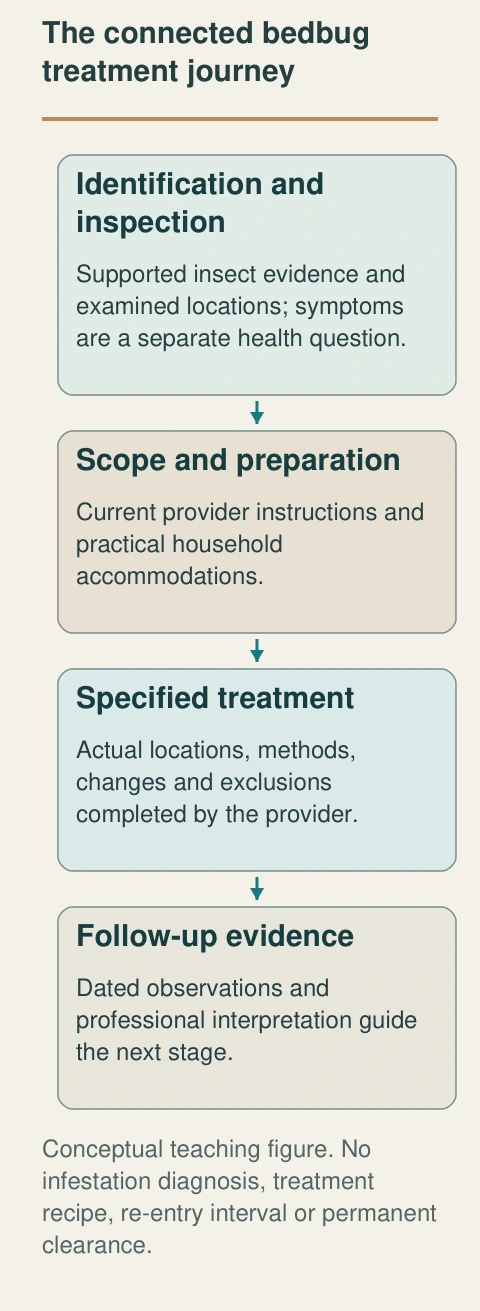
- Identification and inspection
Supported insect evidence and examined locations; symptoms are a separate health question.
- Scope and preparation
Current provider instructions and practical household accommodations.
- Specified treatment
Actual locations, methods, changes and exclusions completed by the provider.
- Follow-up evidence
Dated observations and professional interpretation guide the next stage.
What does this illustration leave out?
No infestation diagnosis, treatment recipe, re-entry interval or permanent clearance. This illustration explains an idea. It is not an installation guide.
Which milestone is actually supported by the current record?
Explore this with HomeAI ↗Opens an editable question. Nothing is sent until you choose to send it.The sleeping surface is only one inspection location
The bed, bedside furniture, chair and suitcase share a bedroom. These separate objects explain why a professional inspection and movement plan can concern more than the top of the mattress.
Numbers identify the parts explained below.
- Bed and frame
A sleeping-area object with several interfaces.
- Nearby furniture
Separate locations whose actual status needs findings.
- Suitcase
Belongings can introduce a movement question without proving this object affected.
What does this illustration leave out?
Clean illustrative room; no insect, infestation extent, bite cause or clearance. This illustration explains an idea. It is not an installation guide.
Which actual locations did the professional inspect?
Explore this with HomeAI ↗Opens an editable question. Nothing is sent until you choose to send it.Read the complete figure
The connected bedbug treatment journey
Identification, scoped access, treatment and follow-up answer different questions. The actual professional plan governs each stage.
- Identification and inspection
- Supported insect evidence and examined locations; symptoms are a separate health question.
- Scope and preparation
- Current provider instructions and practical household accommodations.
- Specified treatment
- Actual locations, methods, changes and exclusions completed by the provider.
- Follow-up evidence
- Dated observations and professional interpretation guide the next stage.
What remains unknown: No infestation diagnosis, treatment recipe, re-entry interval or permanent clearance.
A useful question: Which milestone is actually supported by the current record?
Can bites or a bedroom photograph identify bedbugs?
A skin reaction is a health observation, not an insect identification. People can react differently and a photograph of a mark cannot establish its cause. Health Canada describes varied reactions and directs health concerns to a healthcare professional. Keep the person’s symptoms with appropriate care advice, while the pest investigation considers physical evidence and the actual room.
Health Canada describes adult bedbugs as small, flat, oval, wingless and brown; young insects have a similar shape but are smaller and lighter. They feed on blood and use narrow protected hiding places. Those ordinary features explain why identification needs more than a skin mark or an untidy-looking seam. They are recognition clues, not a household diagnosis: a suitable professional still needs usable physical evidence to identify the insect and assess the affected locations.
Record the location and date of a safe observation, preserving the original image and a plain description. Attribute another person’s report rather than turning it into your own finding. A suspected insect, an identified insect and a confirmed affected location are different milestones. This distinction helps the provider investigate without either dismissing the concern or expanding it into a whole-building claim.
Do not open electrical outlets, dismantle furniture or enter unsafe spaces to collect evidence. Health Canada names concealed locations to explain the pest’s behaviour, not to authorize owner access to every hiding place. The actual inspection plan should identify who will examine which locations and how access is handled. The guide supplies no capture procedure, diagnostic photo key or medical judgement about a bite.
What do the adult and young-insect features explain?
Adult and young bedbugs share a broad oval outline; young insects are smaller and paler. This enlarged conceptual comparison helps explain the features named in the identification discussion. It is not a specimen identification or a test for the cause of a skin mark.
Numbers identify the parts explained below.
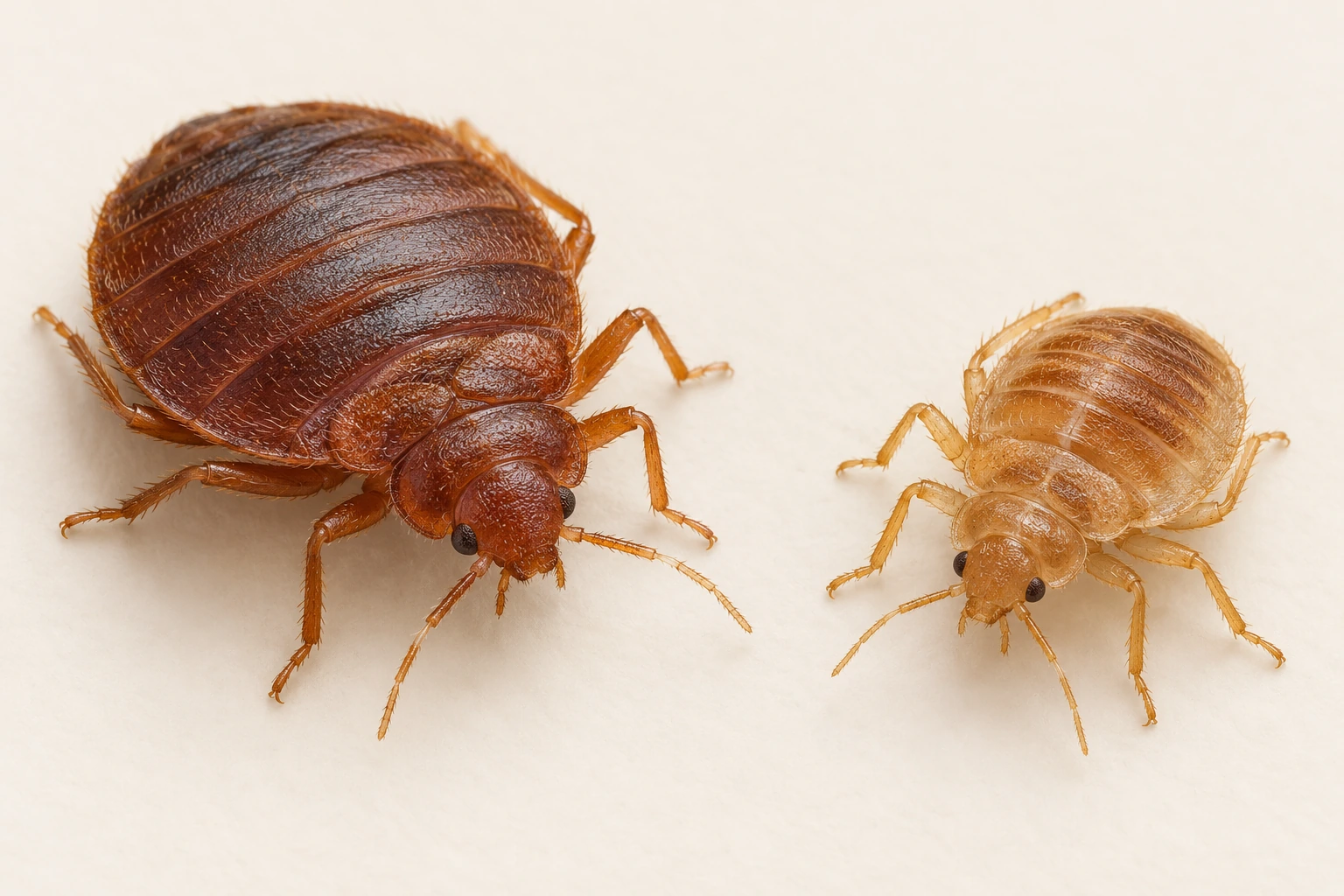
- Adult outline
Shows the broad, flat body described in the source; appearance is a clue for a qualified identification.
- Young insect
Retains the basic shape while appearing smaller and lighter; colour alone does not determine an actual specimen's stage.
- Low-profile body
The broad, low, wingless outline helps explain protected hiding. The picture is enlarged, not a specimen key or usable size comparison.
What does this illustration leave out?
Illustrative anatomy and relative size only; no scale, exact growth stage, feeding state diagnosis, actual specimen identity, bite cause or infestation finding. This illustration explains an idea. It is not an installation guide.
What physical evidence can the pest professional identify, and what separate question remains about the person's symptoms?
Explore this with HomeAI ↗Opens an editable question. Nothing is sent until you choose to send it.What do the adult and young-insect features explain?
Adults and young bedbugs have the same broad, low body plan. Health Canada describes brown adults and smaller, lighter young insects. The enlarged study view makes that relationship easier to see than a bedroom overview can. Actual size, colour and apparent shape can vary, so the comparison supplies familiar words for the professional conversation rather than a picture-matching test.
The physical-insect question and the health question need different answers. A pest professional can assess usable insect evidence and the locations examined. A healthcare professional addresses a person's symptoms. Even a supported insect identification does not, by itself, establish the cause of a particular skin mark.
- Broad oval body: Names the general outline described in the source. The illustration is enlarged and does not supply a measurement.
- Low profile and no wings: Help explain concealment and crawling movement. They are not enough to identify a suspected insect on their own.
- Smaller, lighter young insect: Shows why an immature insect need not look as dark or large as the adult example. No exact stage or size ratio is assigned.
- Qualified identification: Connects actual physical evidence to a supported finding. It remains separate from symptoms, arrival history and the affected-room boundary.
Conceptual recognition lesson, not a specimen key, medical diagnosis, feeding-state test or infestation finding. US EPA corroboration is used only for the six-leg drawing constraint; Canadian guidance governs the broader source context.
A useful next question: What was physically identified, who identified it, and which locations were actually examined?
Further reading: Health Canada: Bedbugs — what are they?; US EPA: Bed Bug Home Card (narrow anatomy corroboration).
Source geography, edition and reading scope
Health Canada: Bedbugs — what are they?. Canada — general non-diagnostic identification and behaviour education Page details December 15, 2022; current retrieval does not create a newer publication date. Flat oval wingless brown adults, smaller lighter young, blood feeding and protected hiding places explain inspection questions. These cues do not identify a specimen, a bite cause or infestation extent. No treatment interval, recipe or medical reassurance is adopted. Entire returned primary body, 117 lines, personally read October 20. Complete response retained in health-canada-full-web-body.json. A separate ordinary HTTP retention attempt timed out and remains held.
US EPA: Bed Bug Home Card (narrow anatomy corroboration). United States federal educational card; biological drawing corroboration only, not Canadian law or a property diagnosis Undated returned NEPIS card text; printed/OCR identifier renders EPA735-F-l1-008 with spacing irregularities. No calendar publication date, later revision or current clinical protocol inferred. Six-leg, flattened, wingless oval insect depiction corroboration alongside the fully read Canadian Health Canada description. No US registration, treatment, specimen collection, medical reassurance, numeric size key or regulatory advice adopted. Complete returned primary card text, including repeated identification/front/back panels, personally read October20; retained epa-bedbug-home-card.html/.txt and epa-capture-receipt.json. No source photograph, linked page or clinical literature claimed inspected.
Evidence with different questions
- Skin symptomsHealthcare concern; no insect identification.
- Suspected insectPhysical evidence needing suitable identification.
- Inspected affected areaQualified finding within stated locations and access.
No diagnosis supplied.
Further reading: Health Canada · Bedbugs: what are they?.
Why do the bed frame and nearby room matter?
A bed includes several connected parts: sleeping surface, supporting structure and interfaces with the room. Nearby furniture and small gaps can provide additional protected locations. The visible tidiness of a room is a different observation from the professional finding about its concealed locations. The inspection question is where suitable evidence and access exist in the actual setting, rather than whether one mattress looks clean.
The close bed-frame picture shows ordinary seams and joints as context. Its function is to explain why the provider may discuss more than the exposed top surface. The image contains no labelled colony or diagnostic residue. It cannot establish a particular infestation, tell the owner where to apply a product or determine which item should be retained.
Ask the professional to explain the scope in familiar room terms. Does the inspection cover the bed, nearby furniture, baseboard interfaces and other relevant locations? Which areas remain inaccessible or outside the assignment? The answer should be tied to the provider’s actual findings and method. An inspection of one object should not silently become a finding about every room.
Preserve a room-level account with any detailed finding. A close photograph can be hard to place later unless its location and date are known. The record can state what the provider identified, what was examined and which question remains. Do not confuse an item being present in the room with evidence that it is infested; that decision belongs with the appropriate inspection and plan.
The relationship to sleeping areas concerns access to a host and protected hiding places, rather than a requirement that the insects remain on a sleeper or the mattress surface. That distinction helps explain why an owner can notice a problem without seeing an insect at every inspection. It also avoids a misleading conclusion that an apparently empty sleeping surface clears the bed frame or nearby furniture. Ask the provider to connect each supported finding with its room location and the inspection limits, keeping the pest’s general behaviour separate from the actual extent in this home.
Seams and joints explain a hidden-location question
The intact mattress seam and bed-frame joint show small protected interfaces beside the sleeping surface. They help explain why a visible clean top cannot answer every inspection question.
Numbers identify the parts explained below.

- Mattress seam
A small interface beside the visible sleeping surface.
- Bed-frame joint
A separate protected geometry in the supporting object.
- Intact surfaces
No owner opening or specimen identification is implied.
What does this illustration leave out?
No real insect, egg, diagnostic spot, treatment access instruction or infestation finding. This illustration explains an idea. It is not an installation guide.
What evidence supports the actual identification and inspected extent?
Explore this with HomeAI ↗Opens an editable question. Nothing is sent until you choose to send it.Why can an empty-looking surface leave a hiding question?
A flattened body can fit into a protected joint beside the sleeping area. The section makes that hiding relationship visible; the exposed mattress top and the recess are different viewing locations. This conceptual insect does not establish what is present in a real bed.
Numbers identify the parts explained below.
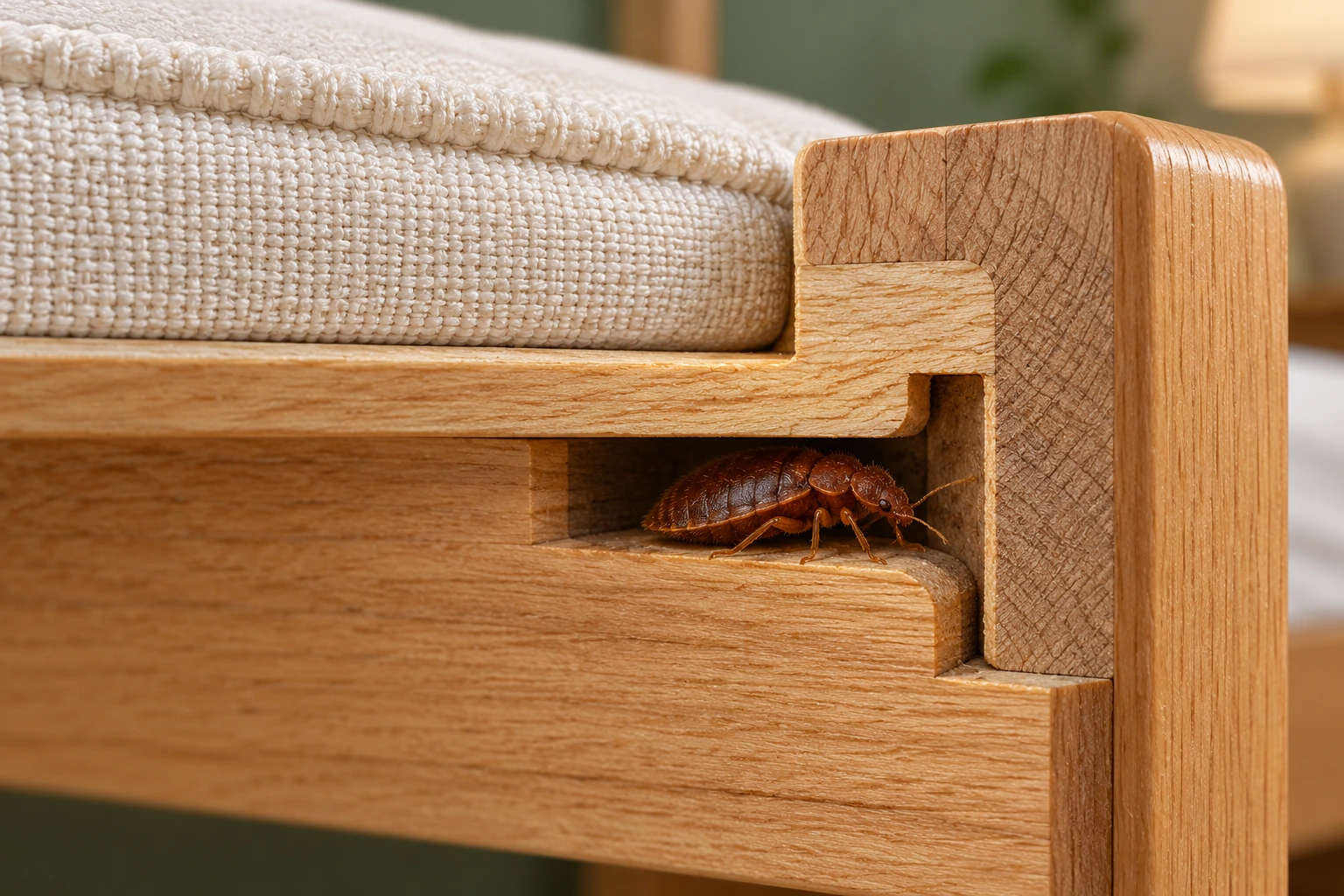
- Protected recess
Provides a sheltered location; its existence helps explain why one exposed surface is not the whole inspection scope.
- Low body profile
Explains how the insect can occupy a small space; the illustration supplies no usable gap measurement.
- Exposed bed edge
Offers different visibility from the recess; an apparently empty top is a limited observation.
What does this illustration leave out?
No actual insect, measured gap, affected-room boundary, hidden population, movement path or treatment reach is established. This illustration explains an idea. It is not an installation guide.
Which bed and nearby-room locations did the professional actually examine, and which remained inaccessible?
Explore this with HomeAI ↗Opens an editable question. Nothing is sent until you choose to send it.Why can an empty-looking surface leave a hiding question?
The low body profile matters because a protected joint is a different environment from the open sleeping surface. Health Canada links flattened bodies with very small hiding places around sleeping areas. In this section, the joint shelters the illustrative insect while the exposed bed edge remains visible. That is the mechanism the earlier room and seam pictures could not show on their own.
An inspection therefore needs locations and viewing limits. An apparently empty mattress top describes one exposed surface at one time. It does not describe the concealed joint or every nearby item. Ask the professional to explain the examined areas in room language, keeping inaccessible locations visible in the report. Do not dismantle furniture or open electrical fittings to imitate the cutaway.
- Exposed surface: Can be seen during an ordinary observation. Its appearance has a limited location and time.
- Protected joint: Illustrates a concealed location beside the sleeping area. The cut plane is a teaching device, not an access instruction.
- Flattened insect model: Connects body shape with the available hiding space. Neither body nor gap has a usable scale.
- Named inspection scope: Explains which actual places were examined and what remained out of view. It does not infer a hidden population from the model.
One conceptual hiding relationship. No actual insect, concealed extent, room diagnosis or treatment reach is shown.
A useful next question: Which relevant bed and nearby-room locations remained inaccessible, and what does the provider propose to resolve that limit?
Further reading: Health Canada: Bedbugs — what are they?; US EPA: Bed Bug Home Card (narrow anatomy corroboration).
Source geography, edition and reading scope
Health Canada: Bedbugs — what are they?. Canada — general non-diagnostic identification and behaviour education Page details December 15, 2022; current retrieval does not create a newer publication date. Flat oval wingless brown adults, smaller lighter young, blood feeding and protected hiding places explain inspection questions. These cues do not identify a specimen, a bite cause or infestation extent. No treatment interval, recipe or medical reassurance is adopted. Entire returned primary body, 117 lines, personally read October 20. Complete response retained in health-canada-full-web-body.json. A separate ordinary HTTP retention attempt timed out and remains held.
US EPA: Bed Bug Home Card (narrow anatomy corroboration). United States federal educational card; biological drawing corroboration only, not Canadian law or a property diagnosis Undated returned NEPIS card text; printed/OCR identifier renders EPA735-F-l1-008 with spacing irregularities. No calendar publication date, later revision or current clinical protocol inferred. Six-leg, flattened, wingless oval insect depiction corroboration alongside the fully read Canadian Health Canada description. No US registration, treatment, specimen collection, medical reassurance, numeric size key or regulatory advice adopted. Complete returned primary card text, including repeated identification/front/back panels, personally read October20; retained epa-bedbug-home-card.html/.txt and epa-capture-receipt.json. No source photograph, linked page or clinical literature claimed inspected.
How can belongings move the problem to another place?
Belongings can connect one location to another. An insect carried on an affected item can arrive in a different room or property without flying. Health Canada identifies this transport route. The practical consequence is to obtain a movement and handling plan from the pest provider before rearranging the household simply to escape the original sleeping area.
The belongings picture shows ordinary closed storage containers and room furniture as separate locations. It teaches the difference between organizing a plan and declaring an item clean. A closed container’s appearance cannot establish its contents or treatment status. The native movement figure labels reported affected, assessed, treated and still unresolved states without prescribing bagging, laundering or disposal techniques.
Ask which belongings should remain in place, which require preparation, how the provider distinguishes processed from unprocessed items and how movement through shared spaces is managed. Follow the actual instructions, including any accommodations needed by the household. This is especially useful when several people help: everyone needs the same current plan rather than a mixture of online tips.
Do not move possessions to another bedroom, vehicle, storage unit or another person’s home as an unplanned solution. Obtain provider advice for the actual situation. Disposal also needs its own appropriate handling and local requirements; a generic recommendation to throw everything out can create unnecessary loss and spread questions. This guide supplies no item-cleaning method or universal rule that a mattress must be discarded.
Belongings need a status and handling plan
An item’s location and reported status guide questions for the provider. A closed bag or tote is no pest-free finding.
Numbers identify the parts explained below.
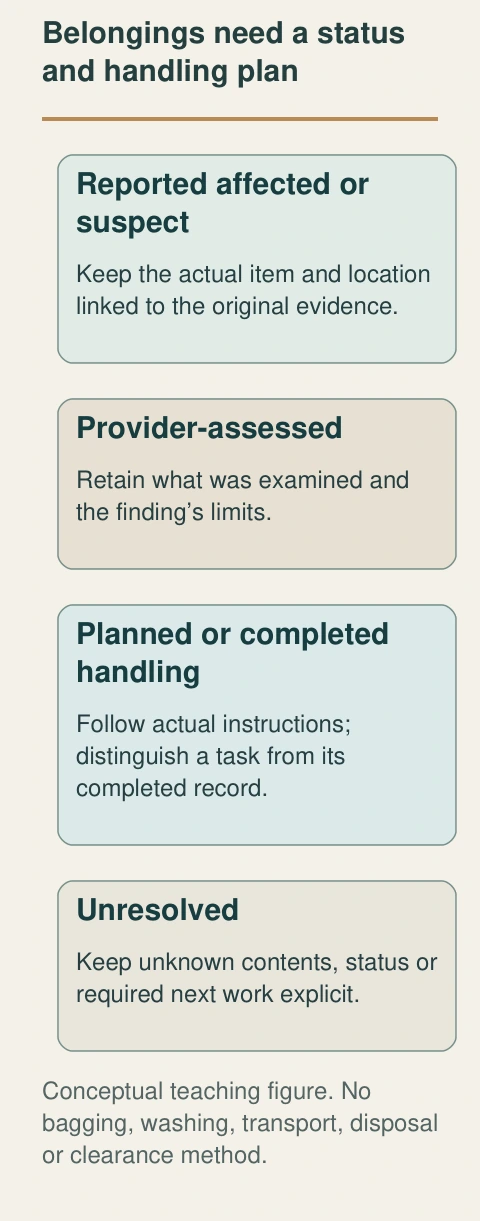
- Reported affected or suspect
Keep the actual item and location linked to the original evidence.
- Provider-assessed
Retain what was examined and the finding’s limits.
- Planned or completed handling
Follow actual instructions; distinguish a task from its completed record.
- Unresolved
Keep unknown contents, status or required next work explicit.
What does this illustration leave out?
No bagging, washing, transport, disposal or clearance method. This illustration explains an idea. It is not an installation guide.
Which current instruction governs this actual item’s next move?
Explore this with HomeAI ↗Opens an editable question. Nothing is sent until you choose to send it.A container’s appearance does not establish item status
The closed tote and bagged clothing sit beside the bed. They explain why a provider’s handling plan and item status matter when belongings are prepared or moved.
Numbers identify the parts explained below.
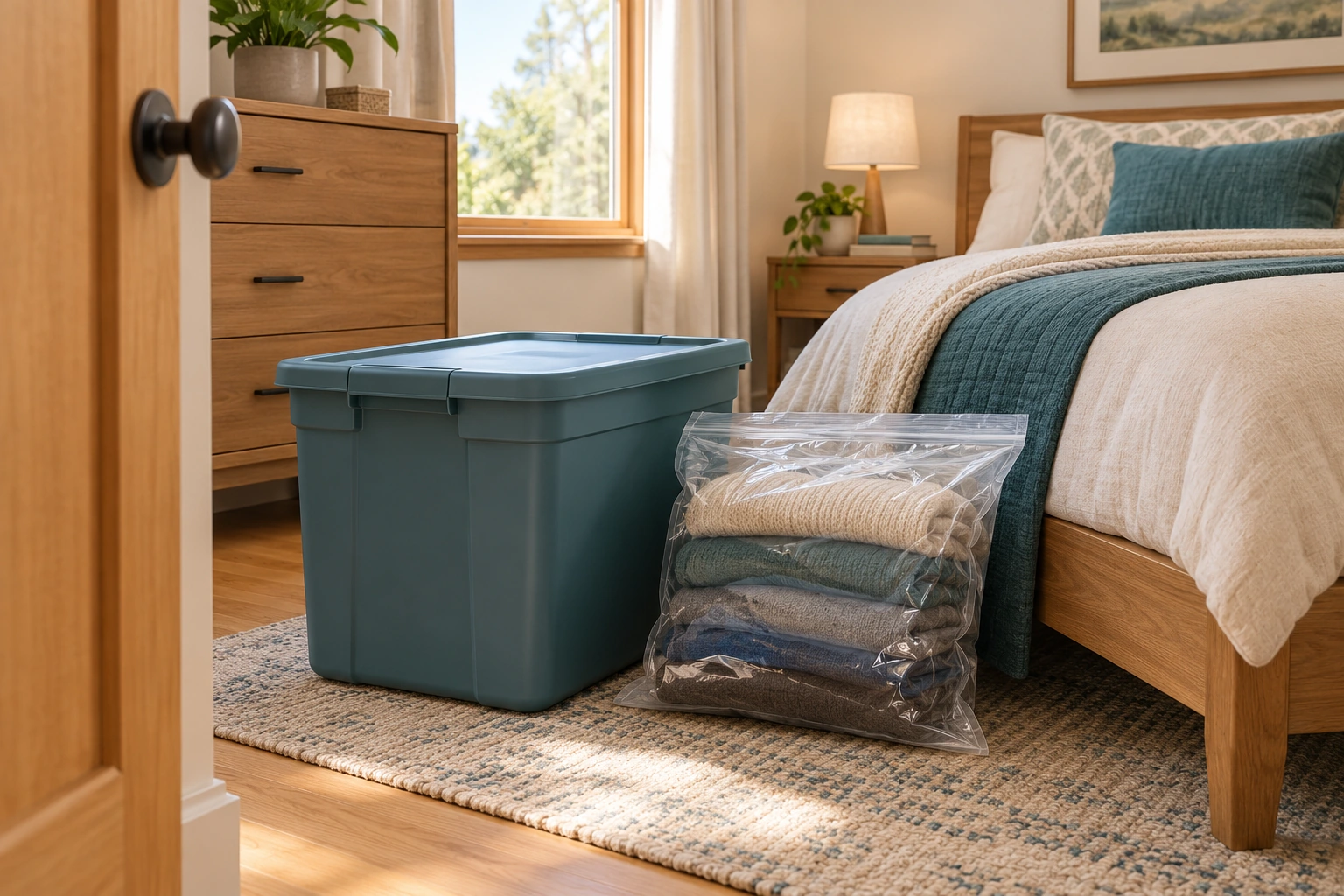
- Closed tote
A visible container, not proof of assessed contents.
- Bagged clothing
A separate item group whose treatment status needs a record.
- Room location
Movement between locations must follow the actual provider plan.
What does this illustration leave out?
No contents diagnosis, sealed-condition certification, cleaning method or pest-free finding. This illustration explains an idea. It is not an installation guide.
Which actual instruction and status govern the next move?
Explore this with HomeAI ↗Opens an editable question. Nothing is sent until you choose to send it.Read the complete figure
Belongings need a status and handling plan
An item’s location and reported status guide questions for the provider. A closed bag or tote is no pest-free finding.
- Reported affected or suspect
- Keep the actual item and location linked to the original evidence.
- Provider-assessed
- Retain what was examined and the finding’s limits.
- Planned or completed handling
- Follow actual instructions; distinguish a task from its completed record.
- Unresolved
- Keep unknown contents, status or required next work explicit.
What remains unknown: No bagging, washing, transport, disposal or clearance method.
A useful question: Which current instruction governs this actual item’s next move?
What should the first professional visit establish?
The initial scope should identify the concern, available evidence, locations to be inspected and what the provider will report. Health Canada strongly recommends a licensed pest-control professional for bedbugs. Confirm the actual qualification and appropriate local licensing arrangement rather than assuming one national credential covers every jurisdiction. Ask how the provider will explain identification, affected extent and any access limitations.
An inspection can establish supported findings within its examined area while leaving another location uncertain. Ask which evidence supports the conclusion and what further access or follow-up is needed. A statement that no evidence was found during one visit should preserve its method, locations and conditions. It should not automatically become a permanent guarantee about the entire property.
Bring the dated event account and any safely obtained images. Say which items have already been moved or treated, if known, because those changes can matter to the assessment. Do not invent a complete history to make the file appear orderly. An unknown arrival date or uncertain source should remain unknown while the provider plans useful next work.
Ask for the next stage in writing: proposed treatment scope, household preparation, access, product or method information where applicable, return instructions and follow-up. These documents have different purposes. A price quote alone does not establish identification; a treatment booking does not establish that preparation is feasible. Resolve practical household constraints with the provider before the plan becomes an appointment everyone interprets differently.
Identification and source attribution are separate questions. A professional may establish that evidence concerns bedbugs while remaining unable to determine when or how they arrived. A recent trip, used object or visitor can be relevant history without establishing blame. Preserve the timing and what is actually known, but do not let an unproven origin become a barrier to arranging the next stage. The treatment plan needs the current affected scope and practical conditions. A confident story about arrival is not a substitute for that present inspection.
Why does preparation need the actual provider’s instructions?
Preparation helps the provider reach the intended locations and coordinate the treatment. Its details depend on the actual method, room, belongings and occupants. Health Canada describes common preparation tasks while emphasizing the pest operator’s specific instructions. This guide does not turn those examples into a universal household sequence. A generic list may conflict with the plan selected for the property.
Ask for a current written preparation sheet and identify who can clarify it. Discuss limited mobility, respiratory concerns, children, pets, storage constraints or another practical issue with the appropriate provider and healthcare professional where relevant. The household should not improvise a substitute method because an instruction is difficult. An agreed accommodation is different from silently leaving a required task incomplete.
The preparation-context picture shows organized room access without depicting pesticide work or a prescribed distance between furniture and walls. It teaches that preparation is a coordination stage. Its visible boxes and bed do not prove completion. The record should say which instructions were issued, which tasks were reported complete and what the provider actually checked.
Keep changes dated. If the provider revises the method or finds another affected location, ask whether preparation changes as well. Replace obsolete working instructions while retaining their history with a clear superseded label. This avoids two helpers following different versions. No washing temperature, dryer time, freezer duration, steam technique or vacuum procedure is supplied here; the actual method and safety requirements govern.
Inspection scope and completed preparation are different
The high room cutaway shows bed, nearby furniture and visible access spaces. An inspection bag and notebook provide work context, while the actual report must identify examined locations and limitations.
Numbers identify the parts explained below.

- Bed and surrounding area
Several distinct locations can belong to a professional scope.
- Visible access spaces
Context for the provider’s current preparation requirements, not dimensions to copy.
- Bag and notebook
Service context is separate from an actual inspection record.
What does this illustration leave out?
No visit occurred in this illustrative room; appearance does not prove preparation, treatment or control. This illustration explains an idea. It is not an installation guide.
Which stage and actual finding does the service record establish?
Explore this with HomeAI ↗Opens an editable question. Nothing is sent until you choose to send it.What different jobs do treatment and prevention perform?
Treatment addresses the identified infestation within a stated scope. Prevention and physical measures address conditions and routes that can undermine control or introduce another problem. Health Canada explains that effective control combines methods and preventive measures. The owner should understand how the proposed components fit together, rather than assuming one product name represents the entire plan.
Ask the provider to explain each component’s purpose in familiar terms: which locations it addresses, what access it needs, what limitations remain and how follow-up is organized. If several visits are proposed, ask what each visit is intended to establish. The number of appointments alone does not measure quality, and a single treatment date cannot settle every hidden location.
A method can have a limited reach. The relevant professional should explain how the actual plan addresses concealed areas, belongings and remaining uncertainty. Do not convert a conceptual statement about insect vulnerability into a home heating, steaming or freezing procedure. Whole-room heat and other specialized methods require appropriate professional design and execution, not an owner’s improvised temperature experiment.
Record planned work and completed work separately. The completion account should identify what was actually done, any exclusions or changes and the next instructions. A receipt establishes a transaction; a useful service report explains the treatment scope. Neither automatically proves successful control. The later monitoring and provider’s interpretation supply additional evidence for the next decision.
Different components can address different parts of the problem. Access makes identified locations reachable. The selected treatment addresses the provider’s defined insect-control task. Handling instructions reduce unintended movement of affected belongings. Monitoring informs later decisions about remaining activity. The provider should explain the connection among those jobs so a household knows why its preparation matters. This is also useful when a proposed component changes: ask which function is being changed and how the rest of the plan is affected, rather than assuming the entire approach has become invalid.
Three stages that need separate records
- PreparationActual current tasks and accommodations.
- TreatmentCompleted locations, methods, changes and exclusions.
- Follow-upDated monitoring, interpretation and next instruction.
Not a procedure or universal schedule.
Further reading: Health Canada · Bedbugs: how do I get rid of them?; Health Canada · Bedbugs: how do I make sure they do not come back?.
Why do product labels and return instructions matter?
Canadian pest-control products have a regulatory identity and label specifying their permitted uses. Health Canada warns against unregistered products and unsafe homemade treatments. A product suitable for one surface or pest is not automatically suitable for bedding, a mattress, a child’s item or another location. This guide provides no pesticide selection, dose, mixing or application instructions.
Ask the pest provider for the actual product and method information relevant to the household, including restrictions and return-to-use directions. Keep the original label or official information with the plan as appropriate. The provider should explain any point the household cannot follow or understand. A familiar brand name or an online claim cannot replace the actual approved use and site-specific directions.
Re-entry and reuse are questions about the actual treatment, product, conditions and household. Obtain the provider’s written instructions and appropriate health advice where needed. This guide gives no universal waiting interval and does not clear a room from absence of smell. A closed appointment ticket is not automatically permission for every person, pet or belonging to return in the same way.
Health Canada specifically warns against ozone generators for bedbug control. Do not substitute an unapproved device or homemade mixture for the professional plan. If exposure or a health concern occurs, obtain appropriate urgent or healthcare advice rather than asking a pest article for medical clearance. Preserve the actual product identity and event account for the responsible professional, while immediate care takes priority over completing the file.
A product’s legal registration and its correct use in a particular room are related but distinct. Registration does not authorize every surface, method or occupant exposure. The actual label and qualified provider’s directions need to match the intended application and subsequent use. Ask who answers a conflict or unclear instruction before the household acts. Retain the original document rather than copying a shortened version that omits an important restriction. This record supports the next professional conversation without turning HomeAI into an application guide or an exposure-clearance service.
What can monitoring after treatment tell us?
Monitoring looks for evidence over time under an actual follow-up plan. It differs from the treatment activity itself. A provider may use suitable observations or devices and interpret them in context. Ask what the method can detect, where it is used, who checks it and what finding should prompt contact. A monitor’s presence alone is not a result.
Health Canada’s follow-up page describes continued attention after control and discusses measures such as interceptors and encasements. The retained page is historical public guidance, not a new universal protocol. Obtain the actual provider’s current instructions for the named items and household. This guide adopts the monitoring purpose without prescribing tape, powders, furniture alteration or a fixed owner checking schedule.
No new sighting is a useful observation when its time, locations and method are known. It does not by itself prove that every concealed location is free of insects. Conversely, a new suspected sign should be identified and interpreted rather than assumed to prove that all previous work failed. Ask the provider how the finding changes the next inspection or treatment stage.
Keep a dated sequence of visits, reported observations, monitor findings and professional conclusions. Preserve the actual completion criterion and any remaining limits. A household feeling more comfortable and a provider reaching a supported control conclusion are different facts, both worth recording accurately. This article supplies no number of symptom-free days, bite-free interval or universal certificate establishing permanent absence.
Monitoring records should keep negative and positive observations in the same context. If a provider checks an identified monitor in one location on one date, retain that location and date even when nothing is found. If another observation occurs elsewhere, do not combine them into one whole-home result. The pattern can become useful when interpreted by the professional with knowledge of the actual method and treatment. It remains a set of bounded observations, not a score whose total automatically determines whether the household is free of insects.
A quiet period and a control conclusion differ
Monitoring needs its locations, method and dates. The professional interpretation keeps the scope and remaining uncertainty visible.
Numbers identify the parts explained below.
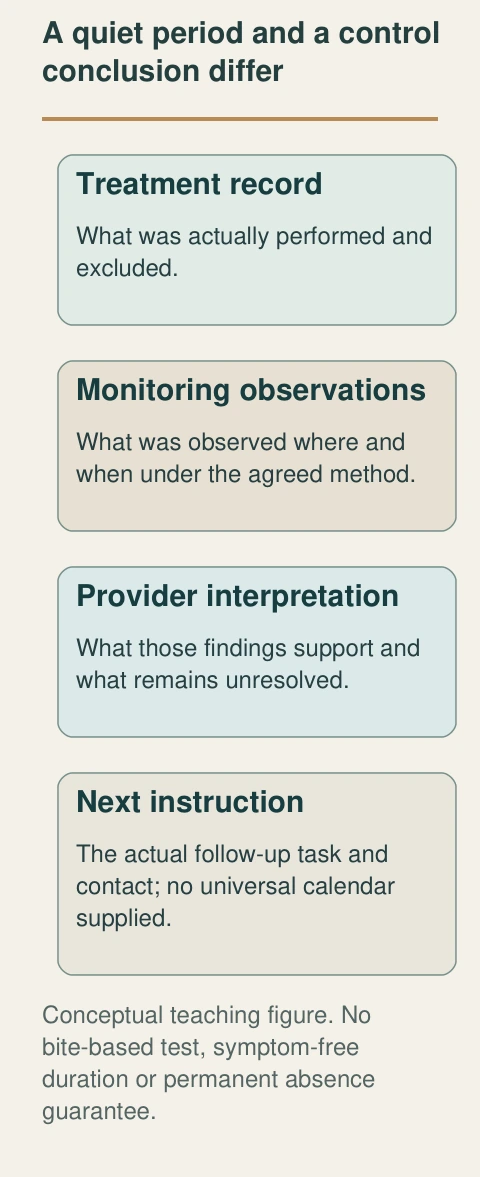
- Treatment record
What was actually performed and excluded.
- Monitoring observations
What was observed where and when under the agreed method.
- Provider interpretation
What those findings support and what remains unresolved.
- Next instruction
The actual follow-up task and contact; no universal calendar supplied.
What does this illustration leave out?
No bite-based test, symptom-free duration or permanent absence guarantee. This illustration explains an idea. It is not an installation guide.
What evidence supports the provider’s actual next decision?
Explore this with HomeAI ↗Opens an editable question. Nothing is sent until you choose to send it.Read the complete figure
A quiet period and a control conclusion differ
Monitoring needs its locations, method and dates. The professional interpretation keeps the scope and remaining uncertainty visible.
- Treatment record
- What was actually performed and excluded.
- Monitoring observations
- What was observed where and when under the agreed method.
- Provider interpretation
- What those findings support and what remains unresolved.
- Next instruction
- The actual follow-up task and contact; no universal calendar supplied.
What remains unknown: No bite-based test, symptom-free duration or permanent absence guarantee.
A useful question: What evidence supports the provider’s actual next decision?
Who coordinates work in an apartment or shared building?
A unit can be connected to shared spaces, neighbouring units and building-management processes. The responsible pest professional and manager should explain how the actual inspection and treatment scope addresses relevant connected areas. This is a coordination question, not proof that every adjacent unit is affected or that one household introduced the insects.
Health Canada advises tenants to tell their landlord promptly and seek local public-health help for relevant issues. Actual reporting, access, payment and tenancy duties depend on the jurisdiction and situation. This guide does not supply legal advice or a national liability rule. Ask the manager, appropriate local authority or qualified adviser which process applies to the address.
Keep communication practical and limited to the purpose. Record the reported unit, concern, dates, provider instructions and outstanding task. Avoid assigning blame from travel history, housekeeping appearance or a rumour. A coordinated plan can require information about connected locations while still protecting personal health details and unnecessary household information.
Ask who maintains the current instructions, how changes reach occupants and who confirms completion of each assigned stage. A manager booking a contractor is a coordination milestone; it does not establish a particular unit’s inspection result or completed preparation. Preserve those distinct records. No landlord notice, neighbour message, customer outreach or appointment is sent by this article.
Shared access can affect the practical plan even when no finding has been made about a neighbour. A corridor, laundry arrangement or storage space may introduce handling and communication questions for management and the provider. Ask which route is relevant and who gives the current instructions. Avoid independently expanding treatment into another person’s unit or moving belongings through shared areas without the agreed plan. Coordination should respond to actual scope and local responsibilities, preserving uncertainty about which locations are affected rather than treating the entire building as one confirmed infestation.
How should costs, belongings and completion claims be compared?
Compare proposals by scope and deliverables before comparing their total. One may cover inspection and a specified treatment, another additional locations or follow-up. Ask how new findings alter the plan and who authorizes changes. This guide gives no price range or guarantee. A more expensive proposal is not automatically broader, and a lower price does not explain what is excluded.
For belongings, ask what the provider’s finding supports before deciding on retention, specialized treatment or disposal. An item’s age, cost or appearance does not identify infestation. A blanket instruction to replace everything can conceal unanswered handling and spread questions. Keep actual item decisions linked to the provider’s plan and local requirements rather than a generic online rule.
Completion language should name the stage. Inspection completed, preparation checked, specified treatment performed and follow-up conclusion reached are different statements. Ask which record supports each one. A warranty or return-visit policy has its own actual terms; it is not proof that recurrence cannot occur. Keep any promotional promise separate from the documented service scope.
When findings change, retain the earlier uncertainty and add the new explanation. This is especially useful if another provider reviews the case. The goal is a readable treatment history, not an immaculate story in which every early suspicion was correct. The file should help the household decide what still needs attention without overstating the effect of a receipt or a single quiet week.
An item record can be simple: familiar description, location, relevant provider finding, planned decision and completed decision. A photograph can help distinguish similar possessions without becoming proof of infestation. Keep an unresolved item separate from one the provider assessed and a reported completed action separate from a verified outcome. This prevents accidental mixing of treated and unassessed belongings in the written history. The provider’s actual handling instructions govern physical movement; the record merely makes the agreed status and next question understandable to the people helping the household.
Completion language should name the milestone
- Appointment completedAn activity occurred.
- Specified work completedActual service scope documented.
- Control conclusionProvider’s interpreted evidence and remaining limits.
No permanent-absence guarantee.
Further reading: Health Canada · Bedbugs: how do I get rid of them?; Health Canada · Bedbugs: how do I make sure they do not come back?.
How can the household manage strain without using symptoms as a test?
A suspected infestation can disrupt sleep and make ordinary marks or sensations feel alarming. Health Canada acknowledges mental-health impacts and directs people to healthcare support. The pest provider assesses insect evidence; a healthcare professional assesses the person’s symptoms and needs. Neither role should be replaced by a photograph-based conclusion or an online reassurance that no one is at risk.
Agree on a manageable reporting arrangement with the provider: what observations are useful, how to contact them and which instructions remain current. A small dated record can be more helpful than repeatedly inspecting everything or collecting unlabelled images. This is organizational advice, not a mental-health treatment or an inspection schedule. Discuss significant distress or sleep problems with an appropriate healthcare professional.
Avoid using skin reactions as the sole measure of treatment success. A person’s reaction and the timing of visible marks do not provide a complete insect-monitoring record. Keep symptoms attributed to the person and professional pest findings attributed to the provider. If the two accounts appear inconsistent, bring each to the appropriate professional rather than forcing them into one unsupported explanation.
Respect practical limits. Preparation and access can be difficult, especially for a household needing assistance. Tell the provider what cannot be done safely and obtain a suitable plan. Do not use hazardous chemicals, room-heating equipment or an improvised ozone device out of frustration. Immediate safety and appropriate care come first; the treatment record is there to support the household, not to become another burden.
How would a fictional household move from suspicion to follow-up?
Avery is a fictional owner who finds a suspected insect near a bed and has unexplained skin marks. The insect has not been professionally identified, and the marks have no established cause. Avery records the safe observation and seeks appropriate healthcare advice for symptoms. A pest professional is asked to assess the physical evidence and actual room, with identification and extent kept as separate questions.
In the invented pest report, the submitted insect is identified as a bedbug. The inspection record names the bed frame and one bedside cabinet; a second room was not examined. Avery can now discuss a plan for the supported finding without describing the entire home as assessed. Insect identification still does not identify the cause of Avery’s skin marks.
Before booking the next stage, Avery asks the provider to put the household’s mobility accommodation and current preparation version into the agreed plan. The second room remains an explicit inspection/follow-up question. If work proceeds, the actual completion record and provider-defined return instructions will be retained separately from the quote. Dated later observations will need the provider’s interpretation; neither one appointment nor a quiet period is renamed permanent clearance. No pesticide, heating or freezing recipe is supplied.
The example ends with a clearer supported history and an explicit next task, not a promised eradication result. It supplies no actual infestation, medical diagnosis, treatment effectiveness, safe re-entry decision or universal schedule. Its lesson is the connected sequence: identify, define scope, prepare appropriately, record treatment, interpret follow-up and keep the remaining household questions with the responsible professional.
What should the treatment record make easy to explain?
Keep the concern and identification evidence first, then the inspected locations, findings and exclusions. Add the actual preparation version, agreed accommodations, completed treatment and return instructions. Preserve product or method identity as appropriate and retain dated follow-up observations and professional conclusions. A useful file tells another provider what happened without pretending every location was assessed.
Separate proposed, reported and verified information. A quote is proposed work. A household’s preparation account is a report. The provider’s completion and assessment records have their own defined scope. A fictional diagram contributes understanding but none of those actual findings. This distinction makes the record more useful for both ongoing care and a later property handover.
Use the rodent guide for its separate entry/food/storage question and the wood-insect guide for timber and structural evidence. The home-care record can retain dated equipment or service tasks without publishing sensitive information. A property professional can help organize a transaction file, while actual pest and health findings remain with the appropriate qualified people.
The reader should finish able to explain why identification, access, coordinated treatment, movement control and follow-up are connected. They should know what one appointment does and does not establish, which current instructions govern the household and who addresses a new sign or symptom. That understanding supports a practical next step while preserving uncertainty about the actual infestation and outcome until suitable evidence exists.
Keep learning about the connected parts
- Rodent signs at home: understand entry, food, shelter and the work that helps
- Why damp walls and mould keep coming back
- Build a home-care record that the next person can understand
- Wood-destroying insects: separate the pest, moisture and structural questions
- Read an inspection report without turning it into a guarantee
Canadian context and authorities · Visual atlas · Learning labs
Practice the distinction.
Avery retains a connected treatment history
Fictional suspected insect and unexplained skin marks; identification, cause and extent are initially unresolved.
Reported observations
- The fictional report identifies the submitted insect as a bedbug.
- The bed frame and one cabinet are listed as inspected; a second room remains unexamined.
- The dated preparation version records a mobility accommodation, while skin concerns remain with healthcare.
Compare the explanations
Expand each possibility to see the evidence needed to distinguish it. Similar symptoms can have different mechanisms.
Physical evidence supports a scoped pest plan
Identification and examined locations can guide the actual next stage.
Qualified findings, current plan and completed service record.
Another area or sign remains unresolved
One visit and a quiet period do not establish permanent absence everywhere.
Dated follow-up and the provider’s interpretation with limits.
A useful next question
Use the identified insect and listed locations to agree the actual provider plan, resolve access/preparation accommodations, and retain the unexamined room and follow-up questions.
No real infestation, bite diagnosis, treatment recipe, effectiveness or re-entry clearance.
Know what the words mean.
- Identification
- A supported finding about the insect or evidence, distinct from a skin symptom.
- Treatment scope
- The locations, items, methods and exclusions in the actual pest-service assignment.
- Preparation
- Household tasks and access arrangements governed by the actual provider’s current instructions.
- Monitoring
- Dated evidence gathered under a stated follow-up method and interpreted in context.
Questions to bring
to the conversation.
- What evidence supports identification, separately from symptoms?
- Which actual areas were inspected and excluded?
- Which current preparation, treatment and return instructions apply?
- What follow-up evidence and professional interpretation support the next stage?
Separate a showing observation, an existing record and a new professional assessment. Unknown means a question remains; it does not automatically mean a defect.
Use the evidence planner ↗Go to the source.
Original HomeAI explanation informed by these public references. Sources support the underlying guidance; they have not reviewed or endorsed HomeAI. Diagrams are conceptual, and calculator outputs depend on your inputs.
Complete current reachable Health Canada identity, treatment and follow-up bodies personally read October 14. Historical 2015 treatment/follow-up dates and 2022 identity date retained. No insect or medical diagnosis, instructions for pesticides, steam, heat, freezing, washing or vacuuming, item-disposal command, universal interval, re-entry clearance, legal liability or real control outcome supplied. Old procedural suggestions deliberately withheld; actual current licensed provider plan governs.
Publication & source review
First published .
Sources reviewed .
Have a question about your home?
Start with the symptom, timing and what you have observed.
Ask HomeAI