- The household supply, washer’s internal water handling and building drainage do different jobs. A puddle near the machine does not identify which one released the water.
- A stopped appliance does not automatically isolate its supply hoses. Drain-hose routing, retention and the receiving drain need the actual model instructions and applicable local assessment.
- Stop using a washer with unexplained leakage or concerning movement and obtain appropriate help. Keep clear of water near electrical equipment; do not move, disconnect or run a leaking machine to establish a cause.
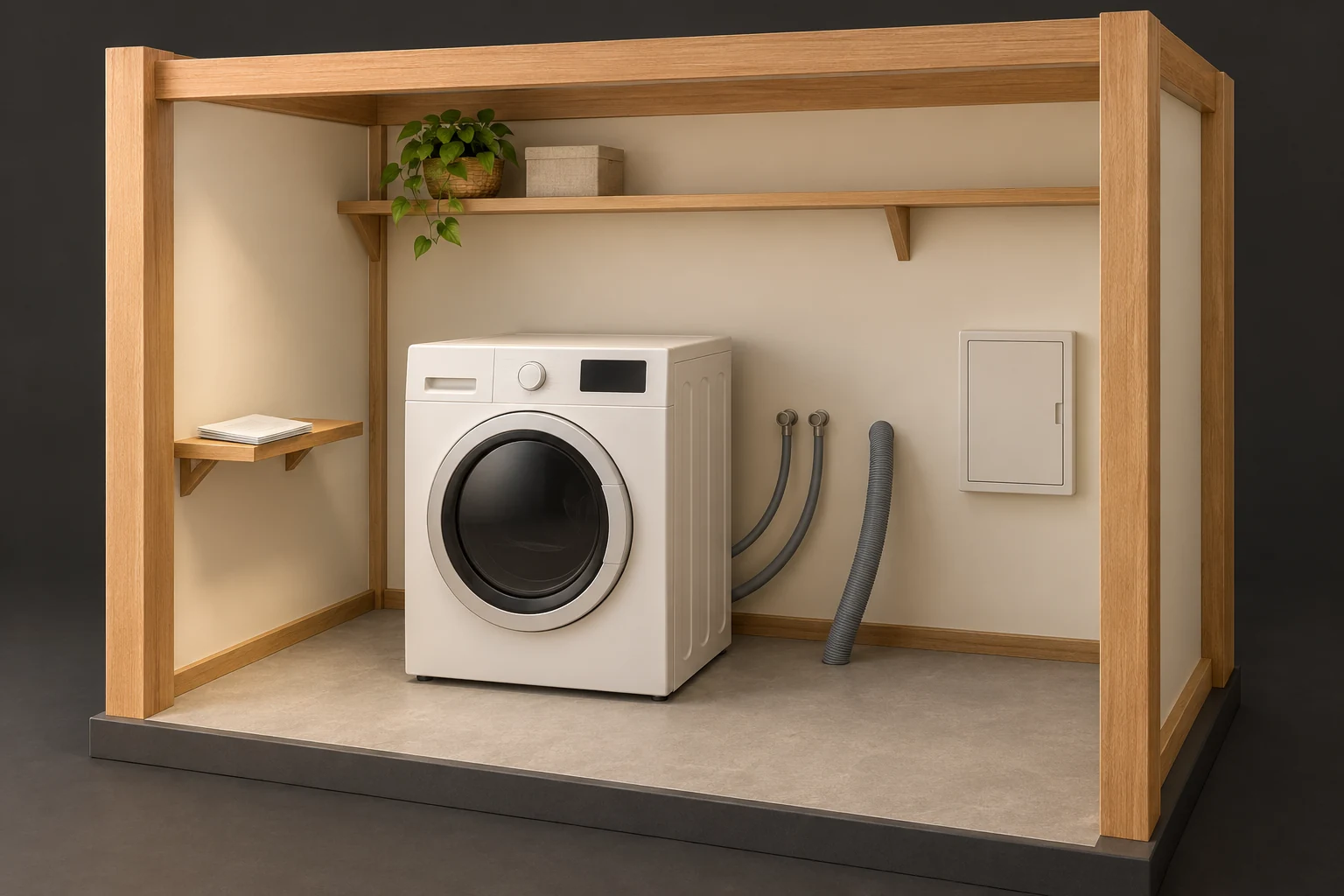
A closed pale cabinet has a circular front door and an unlabelled control face. Two narrow curved forms emerge from behind its side and end at small wall-side forms. A separate broad ribbed form leans nearby; a plain closed wall cover and blank booklet complete the room context.
About this illustration
The scene identifies no washer model, hose material, hot/cold identity, actual hidden connection, valve state, pressure, standpipe, trap, electrical arrangement or leak. It supplies no operating or installation finding. This is a conceptual teaching model, not an assessment of your home.
7 picture lessons appear beside the questions in this guide. Use them to understand the explanation, then consider what it means for your home.
What should I do when water appears during ordinary use?
A washer brings household water into an appliance, holds and moves wash water, then discharges it to building plumbing. Water on the floor can arise at several boundaries along that journey. Begin with the event already noticed: the visible location, approximate time and whether filling, washing or draining was apparent. Stop using equipment with unexplained leakage or concerning movement and arrange the appropriate assessment. Continuing another load to get a better picture can add damage without establishing the source.
Keep away from wet electrical equipment, standing water around the appliance or a wet route to its plug, switches or panel. Do not reach behind the machine to unplug it or touch controls through a wet area. Get appropriate urgent electrical or emergency assistance where required; smoke or fire takes priority over documenting water. A known shutoff is useful only when safely accessible and understood. Do not force an unfamiliar valve. Suspected wastewater backup calls for keeping clear and contacting building management or qualified plumbing help rather than restarting the washer.
Which water jobs belong to the home and which to the washer?
Think of three connected assignments. The household supply delivers water to the identified appliance connections. The washer’s inlet valves and internal delivery arrangement manage filling; its wash process uses that water with the selected load and products. A drain pump then sends used water through the appliance’s discharge hose toward the identified receiving drain. The house must carry that discharge onward. A photograph of the cabinet mainly shows the boundary around those hidden appliance components, not their condition.
Top-load and front-load arrangements have different clothes-loading openings, seals, dispensers and internal layouts. The reviewed LG WM3400CW and Whirlpool WTW5057LW documents are Canadian-market examples, not interchangeable instructions. Establish the actual full model, available serial record and matching documents before assigning a component or required arrangement. A top-load example cannot establish that a front-load washer has the same accessible filter, door seal, drain connection or care task. The useful system sketch names the real supply, appliance and drain handoff while leaving concealed routes explicitly unresolved.
The appliance and its home connections are different questions
A closed pale cabinet has a circular front door and an unlabelled control face. Two narrow curved forms emerge from behind its side and end at small wall-side forms. A separate broad ribbed form leans nearby; a plain closed wall cover and blank booklet complete the room context.
Numbers identify the parts explained below.
- Closed appliance
The internal fill, wash and discharge functions belong to the actual appliance. A closed exterior reveals no tub, inlet valve, pump condition or failed part.
- Separate connection landmarks
The two narrow forms and broader nearby form introduce connection questions. Their appearance cannot establish which actual installed route carries supply or discharge.
- Wall-side context
The plain cover has no identified utility or protective function. Match actual equipment and building connections through the appropriate instructions and assessment.
What does this illustration leave out?
The scene identifies no washer model, hose material, hot/cold identity, actual hidden connection, valve state, pressure, standpipe, trap, electrical arrangement or leak. It supplies no operating or installation finding. This illustration explains an idea. It is not an installation guide.
Which part of the actual water event belongs to the appliance, its external connections or the building drain?
Explore this with HomeAI ↗Opens an editable question. Nothing is sent until you choose to send it.Water entering the machine and water leaving it have different jobs.
Follow the supply, the appliance functions and the handoff to building plumbing. This is a functional explanation, not an installation layout.
- Household supplyThe actual household valve, inlet hoses and fittings deliver water to the washer. When that supply remains connected and open, switching the appliance off does not isolate the upstream hose route.
- Appliance filling and washingThe identified inlet valves and internal delivery arrangement manage filling. The machine uses water within its own model-specific wash process; a closed cabinet does not reveal those components or their condition.
- Pumped dischargeThe washer’s drain pump sends used water along its identified discharge route at the relevant stages. Hose routing and retention are separate actual installation questions, rather than a universal diagram dimension.
- Building drain handoffThe receiving plumbing carries discharge onward. A nearby opening, a clear-looking sink or an appliance-only check does not establish the full connected drain route or its condition.
These roles supply no standpipe height, pressure, capacity, compatible part selection, approved connection or passing test. No draining, hose movement, disconnection or repeat-load experiment is instructed. An unexplained leak needs the appropriate service scope.
Identified Canadian-market examples: LG · WM3400CW washing-machine owner’s manual, MFL71693702 Rev.06_012626 and Whirlpool Canada · WTW5057LW owner/install resource, W11354658A. The current captured LG revision and dated Whirlpool resource apply to their named equipment; actual models and local plumbing requirements must be matched. Read October 4, 2026 (UTC).
Why can a supply connection matter when the washer is stopped?
The appliance’s fill control and the household water isolation point have different jobs. When the household supply remains connected and open, the hose route up to the washer is still part of that supply even if no wash cycle is running. Switching the appliance off does not turn its upstream hose into an empty drain hose. The identified manuals treat electrical disconnection and water-supply isolation separately during their nonuse instructions. This distinction explains why between-load wetness can raise a connection or supply question.
A hose body, its fittings, sealing parts, the household valve and the washer inlet are distinct locations. Visible wetness near one end does not establish which part failed or whether water travelled there from elsewhere. Existing accessible photographs and installation records can show which connections were retained after replacement. Do not tighten, disconnect, stretch or reposition a hose to test that idea. Ask the provider to identify the actual leak location and compatible parts; a new washer cabinet does not prove the inherited household valve or hose route was assessed.
The appliance and its home connections are different questions
A closed pale cabinet has a circular front door and an unlabelled control face. Two narrow curved forms emerge from behind its side and end at small wall-side forms. A separate broad ribbed form leans nearby; a plain closed wall cover and blank booklet complete the room context.
Numbers identify the parts explained below.
- Closed appliance
The internal fill, wash and discharge functions belong to the actual appliance. A closed exterior reveals no tub, inlet valve, pump condition or failed part.
- Separate connection landmarks
The two narrow forms and broader nearby form introduce connection questions. Their appearance cannot establish which actual installed route carries supply or discharge.
- Wall-side context
The plain cover has no identified utility or protective function. Match actual equipment and building connections through the appropriate instructions and assessment.
What does this illustration leave out?
The scene identifies no washer model, hose material, hot/cold identity, actual hidden connection, valve state, pressure, standpipe, trap, electrical arrangement or leak. It supplies no operating or installation finding. This illustration explains an idea. It is not an installation guide.
Which part of the actual water event belongs to the appliance, its external connections or the building drain?
Explore this with HomeAI ↗Opens an editable question. Nothing is sent until you choose to send it.What can filling behaviour tell me about the water path?
Filling is a phase within a cycle, rather than everything the machine does while its power is on. The reviewed LG model may sense a load before water enters, adjust water use and display an estimated remaining time. Its lower visible water level is not by itself a failure finding. A report that the washer was operating is therefore less specific than an already observed fill-stage message, a prolonged filling account or water appearing as filling began. Record what was actually apparent instead of inventing the internal sequence.
Slow or interrupted filling can involve the supply available to the appliance, an identified hose or inlet restriction, the installed connection arrangement or an appliance problem. A displayed inlet message organizes the service question; it does not diagnose one failed valve or prove low pressure throughout the house. The separate pressure and water-hammer lessons explain their measurement questions. Here, provide the exact displayed text and existing timing, without repeated cycles, rapid valve operation, filter removal or a hose-flow experiment. A professional can choose the appropriate appliance and supply assessment.
How does the drain pump hand water to the building?
The washer’s drain pump moves used water out through its discharge route at the relevant stages. The receiving plumbing must then carry the released water away. This is a different job from slowly supplying water into the machine. A discharge event can reveal a receiving-drain problem that is not visible between loads. Conversely, water remaining in the appliance can involve its pump/filter arrangement, the hose route or the outlet conditions, without establishing that the building’s entire sewer is blocked.
The reviewed manuals describe identified standpipe or laundry-tub arrangements, while the Whirlpool resource also describes a separately specified floor-drain arrangement requiring additional provisions. These are alternatives with their own instructions, not permission to put any hose into a convenient floor opening. Ask which arrangement was actually installed, where it hands water to the building and what supports that identification. The washer hose is not a substitute for the building’s drainage and venting assessment. A sink that appears clear or a nearby floor drain does not establish the complete connected route.
The appliance and its home connections are different questions
A closed pale cabinet has a circular front door and an unlabelled control face. Two narrow curved forms emerge from behind its side and end at small wall-side forms. A separate broad ribbed form leans nearby; a plain closed wall cover and blank booklet complete the room context.
Numbers identify the parts explained below.
- Closed appliance
The internal fill, wash and discharge functions belong to the actual appliance. A closed exterior reveals no tub, inlet valve, pump condition or failed part.
- Separate connection landmarks
The two narrow forms and broader nearby form introduce connection questions. Their appearance cannot establish which actual installed route carries supply or discharge.
- Wall-side context
The plain cover has no identified utility or protective function. Match actual equipment and building connections through the appropriate instructions and assessment.
What does this illustration leave out?
The scene identifies no washer model, hose material, hot/cold identity, actual hidden connection, valve state, pressure, standpipe, trap, electrical arrangement or leak. It supplies no operating or installation finding. This illustration explains an idea. It is not an installation guide.
Which part of the actual water event belongs to the appliance, its external connections or the building drain?
Explore this with HomeAI ↗Opens an editable question. Nothing is sent until you choose to send it.Why do hose routing, retention and unintended drainage matter?
A discharge hose has to remain in its intended position while carrying water. The manuals distinguish securing it from sealing the receiving connection airtight, and warn about stretched, pinched, kinked or unsuitable routes. A hose that comes out can discharge outside the intended drain; a restricted route can interfere with discharge. Which attachment, outlet position and receiving arrangement are suitable is an installation question for the actual model and location. A teaching picture cannot supply that decision.
The manufacturer documents also discuss siphoning: an unintended drain-path effect can remove water from the washer rather than retain it for the intended wash process. Their route and connection provisions address that possibility. This differs from simply finding a hole in a hose, and it does not mean every low-water complaint is siphoning. Ask the qualified provider whether the installed arrangement matches the identified instructions and what finding supports any suspected unintended drainage. Do not add tape, push a hose farther into an opening or change its height as an experiment. No universal Canadian standpipe dimension or approved connection is supplied here.
The appliance and its home connections are different questions
A closed pale cabinet has a circular front door and an unlabelled control face. Two narrow curved forms emerge from behind its side and end at small wall-side forms. A separate broad ribbed form leans nearby; a plain closed wall cover and blank booklet complete the room context.
Numbers identify the parts explained below.
- Closed appliance
The internal fill, wash and discharge functions belong to the actual appliance. A closed exterior reveals no tub, inlet valve, pump condition or failed part.
- Separate connection landmarks
The two narrow forms and broader nearby form introduce connection questions. Their appearance cannot establish which actual installed route carries supply or discharge.
- Wall-side context
The plain cover has no identified utility or protective function. Match actual equipment and building connections through the appropriate instructions and assessment.
What does this illustration leave out?
The scene identifies no washer model, hose material, hot/cold identity, actual hidden connection, valve state, pressure, standpipe, trap, electrical arrangement or leak. It supplies no operating or installation finding. This illustration explains an idea. It is not an installation guide.
Which part of the actual water event belongs to the appliance, its external connections or the building drain?
Explore this with HomeAI ↗Opens an editable question. Nothing is sent until you choose to send it.Could the door, dispenser or laundry products change the explanation?
A front-load door and its seal are another water boundary, separate from the rear supply and discharge connections. The LG example identifies caught items, seal contamination or damage among possible leakage explanations. Its dispenser also directs products into the appliance through an identified arrangement. Water first noticed at the front therefore deserves a different description from water visibly emerging at a receiving drain. Location and timing help narrow the assignment, while neither establishes a damaged gasket from a distance.
Detergent matters to water handling as well as cleaning. The reviewed examples specify their suitable high-efficiency products and discuss excessive suds as a possible cause of poor performance or escaping moisture. Foam in an existing account does not prove detergent caused all floor wetness; a plumbing or connection concern may coexist. Retain the product identity, amount if actually known, selected cycle and relevant change. Follow the matched care instructions for ordinary safe use and obtain service for leakage. This lesson gives no chemical mixture, gasket manipulation, cleaning cycle or filter-opening procedure.
Similar-looking connection parts still need an actual identity
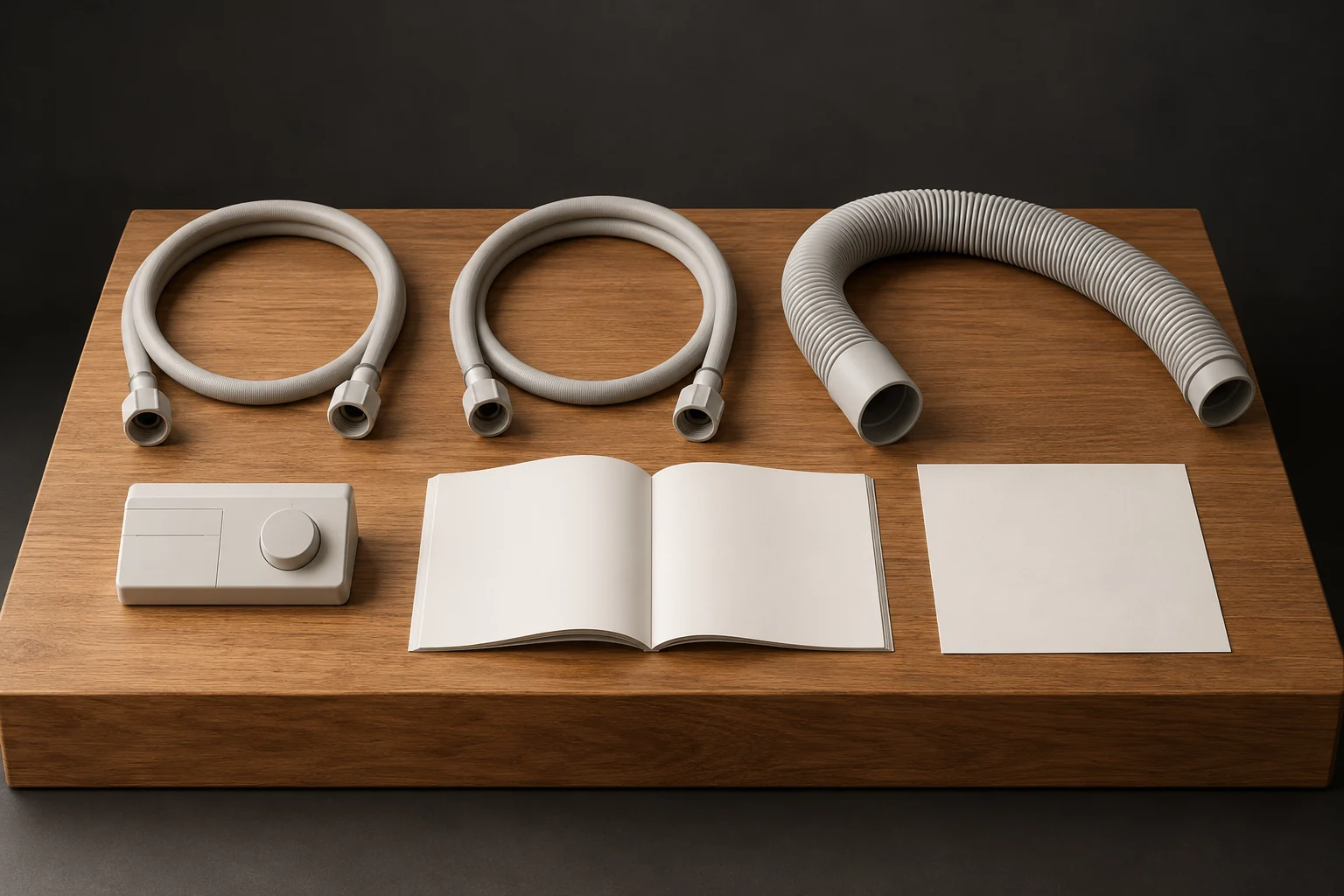
Two narrow hose loops sit beside a broader ribbed curved form. Coupling-like ends are visible. A separate control-like face, blank open booklet and blank record sheet sit in front.
Numbers identify the parts explained below.
- Narrow hose specimens
The actual supply connection has an identity and matching application. These unlabelled forms cannot establish suitability, condition or replacement timing.
- Broad curved specimen
The appliance discharge route and building receiver have separate roles. This loose form supplies no approved route, trapped connection or installation dimension.
- Matching instructions and scope
The blank booklet and record sheet contain no findings. Ask what the exact appliance instructions and completed assessment actually address.
What does this illustration leave out?
The detached forms establish no make, model, material, temperature/pressure rating, compatibility, routed height, connection seal, water direction, protective feature or passing test. No installed drain receiver is shown. This illustration explains an idea. It is not an installation guide.
Do the actual model instructions, connection identities and observed event agree about the handoff being assessed?
Explore this with HomeAI ↗Opens an editable question. Nothing is sent until you choose to send it.What changes after replacement, relocation or unusual movement?
Replacing the appliance can leave much of the surrounding installation in place: supply valves, connection access, receiving drain, floor and concealed plumbing. Relocation adds new route and access questions. The reviewed documents treat installation as a combination of location, connections, support and final checks. A delivery receipt naming a washer is therefore different from an assessment of the inherited water interfaces. Ask which existing components were retained and whether the completed scope covered their relationship to the new machine.
Concerning movement or vibration also belongs in that conversation. The LG example discusses shipping materials, support, leveling and load context as different explanations; these do not identify one cause in another machine. Movement raises a question about the actual installation and adjacent connections, rather than proving a hose was torn. Record the already noticed event and stop using a machine with concerning movement or leakage. Do not pull it forward, tip it, reach underneath, adjust its feet or repeat a spin cycle to obtain evidence. Heavy or stacked equipment needs appropriate qualified access.
Similar-looking connection parts still need an actual identity
Two narrow hose loops sit beside a broader ribbed curved form. Coupling-like ends are visible. A separate control-like face, blank open booklet and blank record sheet sit in front.
Numbers identify the parts explained below.
- Narrow hose specimens
The actual supply connection has an identity and matching application. These unlabelled forms cannot establish suitability, condition or replacement timing.
- Broad curved specimen
The appliance discharge route and building receiver have separate roles. This loose form supplies no approved route, trapped connection or installation dimension.
- Matching instructions and scope
The blank booklet and record sheet contain no findings. Ask what the exact appliance instructions and completed assessment actually address.
What does this illustration leave out?
The detached forms establish no make, model, material, temperature/pressure rating, compatibility, routed height, connection seal, water direction, protective feature or passing test. No installed drain receiver is shown. This illustration explains an idea. It is not an installation guide.
Do the actual model instructions, connection identities and observed event agree about the handoff being assessed?
Explore this with HomeAI ↗Opens an editable question. Nothing is sent until you choose to send it.Does a pan or leak-limiting accessory settle the water question?
An accessory needs to be understood with the actual installation, not treated as a whole-room guarantee. The LG manual discusses particular pan and pedestal conditions and their relationship to support and vibration. It does not establish that every Canadian washer needs a pan, that the pan under another model is compatible or that surrounding concealed materials remain dry. Ask what accessory is present, what its identified instructions cover and how it relates to the appliance’s location and service access.
Compatibility can affect the fill route too. The reviewed LG model warns against certain leak-limiting inlet hoses because their devices can interrupt filling. That is a model-specific boundary, not a verdict on every protection product or permission to remove a device. A braided appearance, accessory name or advertised protective feature cannot establish the compatible arrangement. Have the installer or service provider explain the actual product combination and any specified checks. Keep questions about new automatic protection separate from investigating existing water; purchasing an accessory does not identify the original source.
Similar-looking connection parts still need an actual identity
Two narrow hose loops sit beside a broader ribbed curved form. Coupling-like ends are visible. A separate control-like face, blank open booklet and blank record sheet sit in front.
Numbers identify the parts explained below.
- Narrow hose specimens
The actual supply connection has an identity and matching application. These unlabelled forms cannot establish suitability, condition or replacement timing.
- Broad curved specimen
The appliance discharge route and building receiver have separate roles. This loose form supplies no approved route, trapped connection or installation dimension.
- Matching instructions and scope
The blank booklet and record sheet contain no findings. Ask what the exact appliance instructions and completed assessment actually address.
What does this illustration leave out?
The detached forms establish no make, model, material, temperature/pressure rating, compatibility, routed height, connection seal, water direction, protective feature or passing test. No installed drain receiver is shown. This illustration explains an idea. It is not an installation guide.
Do the actual model instructions, connection identities and observed event agree about the handoff being assessed?
Explore this with HomeAI ↗Opens an editable question. Nothing is sent until you choose to send it.Which ordinary observations and documented checks are useful?
Keep a short account of naturally encountered events: first visible water location, approximate cycle phase, displayed text, load/product context, other nearby water use and known recent work. State what was not visible. Photograph accessible identifiers and stationary context from an ordinary safe position; do not move the machine or remove covers to complete the picture. A clean floor between two loads is an observation for those times, not proof that every connection is sound or that affected materials below it are dry.
A useful installation or service report names the actual model and interfaces assessed, findings, changes, relevant method and conditions, inaccessible portions and follow-up. A documented model-specific fill/drain check can establish the behaviour observed during that check. It does not automatically inspect concealed building plumbing, establish future hose life or resolve an intermittent event absent from the visit. An appliance assessment, a plumbing investigation and a moisture/restoration assessment may answer different questions. Ask which finding supports each proposed task and how its completion will be recorded; do not commission an undefined whole-home pass.
Who should assess this installation in a Canadian home?
Appliance service addresses the identified machine and its internal functions. Qualified plumbing assessment addresses the household supply, valves and receiving/downstream drain questions within its agreed scope. Electrical concerns require the appropriate qualified electrical provider; uncertain affected building materials may need a separate moisture or restoration scope. In a rental or shared building, involve the responsible landlord or building manager before work that needs shared access or services. Physical proximity to the washer does not determine ownership or authority to alter a pipe.
The model instructions and applicable local requirements work together. Manufacturer drain heights, pressure ranges and connection provisions are not a nationwide plumbing-code table, and this guide supplies no permit exemption. Ask the local authority and qualified installer what applies to the proposed work. Canada’s cold-weather context matters where equipment, retained water or hoses were exposed during storage, transport or occupancy; the reviewed manuals explain freezing-related damage possibilities. Exposure does not diagnose damage, and a warm room does not prove the equipment remained frost-free earlier. Arrange model-specific advice without a thawing, antifreeze or restart experiment.
How would a fictional owner separate two water events?
Explicitly fictional learning case: an owner of an invented Canadian home has a new-washer delivery invoice and no clear record of retained hoses or drain review. During one ordinary load, they notice water near the laundry doorway late in the cycle, but never see its first emergence. A later between-load account records dampness near the rear wall. Their detergent product also changed that week. These are separate observations and a recent change; they do not establish one connection failure, drain backup, excess-suds diagnosis or defective new washer.
The owner stops using the leaking machine and keeps clear of the wet area. From safe access they supply the existing chronology, model documents and invoice to the responsible service team, asking for both appliance/interface and building-plumbing scope as appropriate. They request separate findings about any affected materials. If the real provider later confirms a source, its actual report would establish that finding within its stated extent; this example invents no repair result. The owner does not tighten a fitting, open a pump filter or run comparison loads. The next useful outcome is an agreed, bounded assessment rather than a guess presented as certainty.
Practice the distinction.
A new washer, two wet-area accounts and retained connections
Explicitly fictional owner, Canadian home and documents: a delivery invoice names a washer, an existing late-cycle water account and a later between-load dampness account have different timing, and surrounding installation scope is unconfirmed.
Reported observations
- The invented invoice identifies appliance delivery without a retained-connection assessment.
- Late-cycle water was noticed near the doorway, with first emergence unseen.
- A later damp area was noticed near the rear wall between loads.
- A detergent change is documented without an established causal relationship.
Compare the explanations
Expand each possibility to see the evidence needed to distinguish it. Similar symptoms can have different mechanisms.
Supply or appliance connection question
Between-load wetness can raise a supply/interface question, but timing and a rear-wall location do not identify a failed fitting or valve.
Actual accessible context and the qualified provider’s scoped findings.
Discharge, appliance handling or another nearby source
Late-cycle timing and changed laundry products leave several possibilities open; a floor puddle does not prove building backup or excessive suds.
Identified model/arrangement, unchanged chronology and appropriate appliance/plumbing assessment.
A useful next question
Stop using the leaking machine, avoid the wet area and arrange responsible qualified assessment without movement, disconnection, filter opening or comparison loads.
No actual leak source, damaged component, approved installation, passing test, repair outcome, warranty coverage or safe-use clearance is established.
Know what the words mean.
- Washer supply connection
- The identified household-water valve, inlet hose, fittings and appliance inlet interface that delivers water to the machine; it differs from wastewater discharge.
- Washer inlet valve
- The appliance component managing incoming water for its fill function; an off control is not the same as isolating the upstream household supply.
- Washer drain pump
- The identified appliance function that moves used water through its discharge route; it does not establish the capacity or condition of the receiving building drain.
- Washer discharge hose
- The model-specific water-out route between the appliance and its identified receiving drain arrangement, with routing and retention governed by matching instructions and local requirements.
- Receiving drain handoff
- The point where the washer’s discharge is received by its identified building-plumbing arrangement; proximity to an opening does not establish an approved connected route.
- Unintended washer siphoning
- An installation-related drain-path effect discussed in manufacturer instructions that can remove water the wash process was intended to retain; a low visible level alone does not establish it.
- High-efficiency detergent context
- The actual model’s specified laundry-product type and use instructions; foam, product identity and known amount are observations rather than a complete leakage diagnosis.
- Washer interface assessment
- A stated examination of the actual appliance, water connections and receiving-drain relationship, with findings, methods, conditions and exclusions kept distinct.
Questions to bring
to the conversation.
- Does unexplained water, concerning movement or an electrical/wastewater hazard require stopping use and obtaining appropriate help?
- What actual full model, manual edition and installed water arrangement are identified?
- Which supply valve/connection, internal appliance function and receiving drain questions remain separate?
- Where and when was water first actually noticed, and which phase or displayed text was apparent?
- What was retained or changed during delivery, replacement, relocation or service?
- Are any pan, pedestal or protective accessories compatible with the identified equipment and instructions?
- What did the documented check establish under its conditions, and which concealed or intermittent questions remain?
- Who is responsible for appliance, plumbing, electrical, shared-building and affected-material follow-up?
Separate a showing observation, an existing record and a new professional assessment. Unknown means a question remains; it does not automatically mean a defect.
Use the evidence planner ↗Go to the source.
Original HomeAI explanation informed by these public references. Sources support the underlying guidance; they have not reviewed or endorsed HomeAI. Diagrams are conceptual, and calculator outputs depend on your inputs.
Publication & source review
First published .
Sources reviewed .
- LG · WM3400CW washing-machine owner’s manual, MFL71693702 Rev.06_012626
Where this reference applies
Jurisdiction: Identified Canadian-market model example; manual includes separate US and Canada sections, not Canadian plumbing law
Edition: Cover MFL71693702 Rev.06_012626, copyright2020–2026. Canadian support page lists English download February13,2026; listing date is not asserted as the PDF publication date.
Source reviewed: 2026-10-04 · UTC
Separate inlet/connection, appliance fill/wash and drain-pump functions; model-specific hose, drain, location, detergent, door-seal, service and freezing context. Numerical requirements, hose intervals, installation/adjustment/tests, filter opening, chemicals, winterizing/thawing, electrical procedures, warranty interpretation and unsupported generic troubleshooting examples excluded. Conflicting extension-cord wording is retained in evidence and not adopted.
- LG Canada · WM3400CW product/manual support
Where this reference applies
Jurisdiction: Canadian product support establishes the example’s market context, not the identity or edition of a reader’s installed washer
Edition: English manual download listing February13,2026; no substantive page publication date established.
Source reviewed: 2026-10-04 · UTC
Canadian model identity and observed manufacturer link to the captured English manual. No pricing, warranty, availability, service coverage or product recommendation.
- Whirlpool Canada · WTW5057LW owner/install resource, W11354658A
Where this reference applies
Jurisdiction: Manufacturer-served Canadian resource for the named top-load washer family; match actual installed model/revision and local requirements
Edition: Cover W11354658A / W11354659-SP; final footer©2019 Used under license in Canada. No newer edition or current national adoption inferred from successful capture.
Source reviewed: 2026-10-04 · UTC
Supply versus drain interfaces; alternative identified drain arrangements, hose retention and siphoning context, installation/relocation scope, detergent and residual-water/freezing explanation. All numbers, intervals, installation/connection/adjustment/check cycles, chemical and winterizing procedures excluded.
- Whirlpool Canada · Washer safety/install supplement, W11646252C
Where this reference applies
Jurisdiction: Manufacturer Canadian resource associated with the named model family; supplement explicitly does not replace full installation instructions
Edition: W11646252C, final footer08/23 and©2023. Mixed front-load/top-load notes are not assigned automatically to every model.
Source reviewed: 2026-10-04 · UTC
Qualified electrical/service boundaries, heavy-appliance access, supply/drain separation, compatible instructions, nonuse and freezing/transport context. No wiring, lifting, connections, restart, cleaning, thawing, numerical specification or generic maintenance schedule.
- Whirlpool Canada · WTW5057LW owner-support context
Where this reference applies
Jurisdiction: Canada; example identity and support context only
Edition: No substantive publication date established.
Source reviewed: 2026-10-04 · UTC
Identifies the Canadian support context of the example. A resource filename or landing page does not establish the matching edition for a particular serial number.
- Whirlpool · Front-load washer water-leak alternatives
Where this reference applies
Jurisdiction: Manufacturer front-load support page with distinct Canadian and US service links; illustrative alternatives, not a national installation rule
Edition: Captured page displays Last updated without a readable date; no publication/update date invented.
Source reviewed: 2026-10-04 · UTC
Connection leaks, loose discharge hose, building-drain backup and excessive-suds alternatives. Capacity number, tightening/disassembly/check procedures, branded detergent promotions, discounts and service-availability promises excluded.
- Electrical Safety Authority · Flood safety
Where this reference applies
Jurisdiction: Ontario electrical regulator; wet-electrical physical safety guidance, with Ontario licensing/notification procedures kept local
Edition: No substantive publication/update date established; copyright2026 is not a publication date.
Source reviewed: 2026-10-04 · UTC
Electricity can travel through water/wet flooring; keep out of wet electrical areas, obtain utility disconnection where appropriate and qualified assessment before reuse. No owner electrical-isolation procedure, Ontario process nationalization, numerical clearance, insurance or reconnection guarantee.
- Health Canada · Guide to addressing moisture and mould indoors
Where this reference applies
Jurisdiction: Canada national moisture/mould guidance, not a washer installation specification or property diagnosis
Edition: Document says Published January2023; Page details footer says2020-04-09. Conflict retained without inventing a newer edition.
Source reviewed: 2026-10-04 · UTC
Leak source/control and affected-material drying are separate; concealed cavities and unresolved moisture may require qualified assessment. No symptoms/medical diagnosis, numeric growth deadline, humidity/mould threshold, sampling clearance, DIY cleanup, chemical, breaker/rubber-boot, washer-door-open or pipe-extension instruction.
- City of Calgary · Homeowner electrical and plumbing permits
Where this reference applies
Jurisdiction: Calgary, Alberta municipal application/inspection guidance; not a Canadian-wide authority, exemption or legal interpretation
Edition: No substantive publication date established; fresh transport Last-Modified not asserted as content edition. Page says its information has no legal status and is not an official interpretation.
Source reviewed: 2026-10-04 · UTC
Shows that the named local authority separates permit, eligibility, contractor and inspection questions. No permit exemption, fees, thresholds, owner installation/repair procedure, code-adoption claim or inspection certification generalized.
Have a question about your home?
Start with the symptom, timing and what you have observed.
Ask HomeAI